
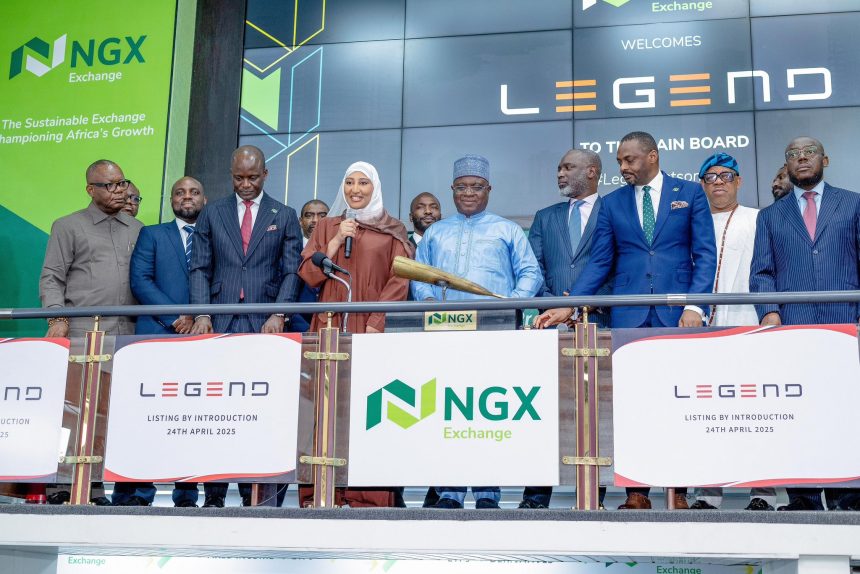
Legend Internet Plc, Nigeria’s first publicly listed internet service provider (ISP), has reported profit growth in its latest financial results, but its cash flow situation suggests the company may be walking a tightrope. Despite stronger earnings, Legend is grappling with liquidity pressures, rising expenses, and a mounting reliance on short-term borrowing.
Revenue and Profit Performance
For the financial year ending July 31, 2025, Legend Internet posted revenues of ₦1.19 billion (about US$799,000), representing a modest 4% increase from the previous year.
The company’s gross profit rose to ₦761.4 million (≈ US$511,000), up from ₦677.4 million in 2024, reflecting stronger cost management on sales.
Net profit after tax surged 44% to ₦172.7 million (≈ US$116,000), with earnings per share climbing from 6 kobo in 2024 to 9 kobo in 2025. This sharp uptick underscores the company’s ability to deliver improved margins, at least on paper.
The Cash Flow Puzzle
Beneath the headline profit figures, however, lies a troubling cash flow picture.
-
Net cash from operating activities fell into the red, recording –₦72.6 million compared with positive operating cash flow a year earlier.
-
Cash and cash equivalents shrank to just ₦21 million (≈ US$14,000) by July 2025.
-
Meanwhile, the company owed ₦49 million (≈ US$33,000) in overdrafts, forcing a heavier dependence on short-term borrowings, which rose by nearly ₦50 million during the year.
Legend’s current liabilities swelled to ₦464.8 million (≈ US$312,600), but the company reported no long-term debt obligations.
This financial posture suggests Legend may be struggling to convert its accounting profits into actual liquidity — a warning sign for investors.
Volatile Quarterly Results
Legend’s performance also showed significant volatility across the year.
-
In the third quarter, profit after tax slumped more than 50% to ₦32.9 million (≈ US$22,000). This was largely due to a threefold rise in operating expenses, driven by higher costs for staff, consultancy services, and marketing. Earnings per share dropped to 2 kobo, compared with 7 kobo in the same period last year.
-
The ISP bounced back in the fourth quarter, tightening control of its cost of sales and improving gross margins, even as revenue dipped slightly.
This swing illustrates the company’s fragile balance between growth spending and profitability.
Assets and Equity
Legend’s balance sheet showed total assets of ₦3.34 billion (≈ US$2.24 million), up from ₦3.03 billion the previous year. A large portion of this value — more than ₦2.6 billion — is tied up in fibre infrastructure investments, underscoring the capital-intensive nature of the telecom sector.
Shareholders’ funds stand at ₦2.87 billion, slightly below the prior year, while retained earnings climbed to ₦734.6 million (≈ US$493,500).
Importantly, the company reported no impairments, asset pledges, or long-term debt obligations, giving it some breathing room in asset integrity and solvency.
Strategic Outlook
Despite inflation in Nigeria topping 33%, Legend Internet has stated it intends to maintain stable pricing for customers, a decision that could preserve market share but may strain margins further if costs continue to rise.
Analysts note that Legend’s listing gave it a first-mover advantage in visibility and investor access. However, sustaining that edge will depend on its ability to:
-
Strengthen operational cash flows,
-
Control spiraling overheads, and
-
Finance infrastructure expansion without overreliance on costly short-term debt.
What This Means
Legend’s financials illustrate a paradox familiar to many young, capital-intensive companies: profitability without liquidity. While the ISP is booking profits and expanding assets, its negative operating cash and shrinking reserves highlight the challenge of scaling in Nigeria’s competitive internet services sector.
Unless Legend can quickly align its profit growth with cash generation, analysts warn the company could face a crunch that limits its ability to fund growth or even maintain existing operations.
For investors, the results are a reminder that headline profits are not enough — cash remains king.