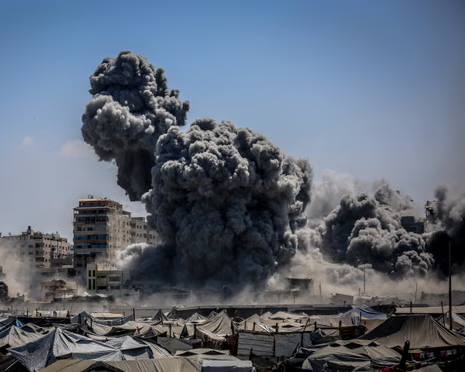
A fragile truce between Israel and Hamas faced a new setback on Wednesday after an Israeli airstrike killed one civilian in southern Gaza, marking the first casualty since the temporary ceasefire began earlier this month.
Local health officials confirmed that the strike hit a residential area in Khan Younis overnight, leaving one man dead and three others injured, including a child. Witnesses described a sudden blast that shattered the brief calm many residents had begun to hope would last.
Dr. Yousef Abu Reida, a medic at Nasser Hospital in Khan Younis, said: “The explosion happened near a building where displaced families were sleeping. We received one fatality and three people with shrapnel wounds. One of them is a small child.”
The Israel Defense Forces (IDF) said the strike was carried out in response to what it described as “an attempted rocket launch from Gaza.” The army said it targeted a “militant position,” though Palestinian officials maintain that the victims were civilians.
The renewed violence coincided with a visit by US Vice President J. D. Vance to Israel, where he met with Prime Minister Benjamin Netanyahu and other senior officials to discuss ways to sustain the fragile ceasefire.
Speaking after the meeting, Vance said he remained optimistic about the peace efforts. “There is great optimism for progress, but also an understanding that peace will not hold unless both sides commit to restraint and dialogue,” he said.
His visit marks the highest-level US diplomatic mission to the region since the truce began three weeks ago, following mediation efforts by Egypt and Qatar.
The ceasefire was designed to allow humanitarian aid and prisoner exchanges between Israel and Hamas, but violations have persisted. Gaza’s Health Ministry reports that more than 90 Palestinians have been killed since the truce started due to isolated air raids, border clashes, and drone strikes.
Israeli officials insist that the IDF remains committed to the ceasefire but will continue to “neutralize threats.” Defense Minister Yoav Gallant said: “We will not tolerate rocket fire or any attempt to harm our people. Israel has the right to defend itself even during a ceasefire.”
For many Gaza residents, however, the word “ceasefire” has lost meaning. “Even when they say there’s peace, we still hear drones every night,” said Amal Hassan, a mother of three sheltering in Rafah. “We just want to live without fear.”
The humanitarian crisis in Gaza continues to worsen. Thousands of homes remain destroyed, electricity supply is limited to a few hours per day, and hospitals are struggling to treat the wounded amid severe shortages of medical supplies.
Aid convoys have been allowed to enter through the Rafah crossing, but relief workers say the deliveries are insufficient. “We need consistent access, not symbolic convoys,” said a representative of the Red Crescent. “People are hungry, homeless, and traumatized.”
The United Nations and several human rights organizations have condemned the renewed violence, warning that civilian lives must be protected. In a statement, UN Secretary-General António Guterres said: “Every civilian death is a tragedy. The continuation of these attacks undermines the ceasefire and prolongs the suffering of innocent people.”
Human Rights Watch urged both sides to honor their commitments under international humanitarian law and called for an independent investigation into all reported strikes that have resulted in civilian deaths.
Despite mounting pressure, peace negotiations remain stalled. Analysts say that without direct dialogue between Israel and Palestinian leaders, every ceasefire will only serve as a temporary pause.
Dr. Lina Abu-Said, a political science lecturer in Ramallah, said: “There can be no real peace until both parties agree to talk sincerely about long-term coexistence. Military restraint alone cannot solve a political problem.”
Vice President Vance concluded his trip with a call for renewed global effort. “Peace may seem far away,” he said, “but every step toward dialogue brings us closer to ending the suffering of innocent people.”