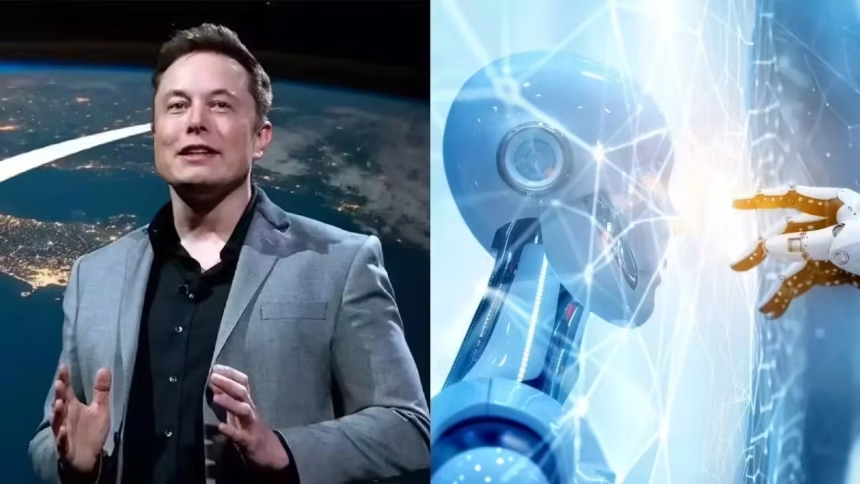
Tech billionaire Elon Musk has once again sparked global debate with his bold prediction that artificial intelligence (AI) and robotics will soon replace every human job. Speaking at recent public events and in interviews cited by outlets including Mashable India, Yahoo News, and Forbes, Musk said that the rapid rise of automation will completely transform how societies function, making employment optional rather than essential.
A World Without Jobs
According to Musk, AI will reach a level of capability where it can perform all forms of work from manual labor to complex analytical roles, more efficiently and cost-effectively than humans. He compared this coming transformation to the shift from growing one’s own food to buying it from stores, suggesting that society will eventually view “having a job” as a personal choice rather than a necessity.
“There will come a point where no job is needed,” Musk said. “If you want to do a job for personal satisfaction, you can. But AI and robots will do everything else.”
Musk envisions this future as a natural outcome of technological progress rather than a dystopian scenario.
From Universal Basic Income to “Universal High Income”
To support people in this AI-driven economy, Musk has proposed a model he calls “universal high income.” Building on the idea of universal basic income (UBI), his concept goes further, predicting that as AI dramatically reduces production costs, most goods and services will become nearly free. This, he argues, would enable everyone to live comfortably without needing traditional employment.
“In a world where AI produces everything you need, people will have more time for leisure, creativity, and community,” Musk said.
The Shift Is Already Underway
Musk’s comments come amid widespread concern about job automation across industries. Reports suggest that companies like Amazon are testing AI-driven systems that could replace hundreds of thousands of human roles in logistics, retail, and customer service.
Economists note that AI has already begun to reshape sectors such as finance, healthcare, transportation, and manufacturing, accelerating a process known as technological unemployment.
However, while Musk believes full automation is inevitable, many experts say the transition will take decades, unfolding gradually as new technologies mature and social systems adapt.
Opportunities and Challenges Ahead
Despite his optimism, Musk acknowledges that a world without work poses major challenges. Governments will need to rethink how to fund public services and distribute wealth in a system where traditional wages disappear. There will also be deep psychological and cultural adjustments, as work has long been tied to identity, purpose, and community.
Human resources experts and economists largely agree that while AI can enhance productivity, the transition will require reskilling programs, policy innovation, and social reforms to prevent inequality from widening.
“The biggest question is not whether AI can do the work,” said one analyst, “but how society can redefine value and purpose when work is no longer central to life.”