This is 2026, but did you know Ethiopia is still in 2018?
At first, it sounds impossible. A clever joke, perhaps. But in Ethiopia, it is simply reality.
While much of the world follows the Gregorian calendar, Ethiopia measures time through an older, deeply rooted system, one that reflects ancient scholarship, spiritual tradition, and a worldview shaped by nature rather than modern convention. The result is a country that lives seven to eight years “behind” the global calendar, not because time paused, but because history took a different path.
A calendar shaped by ancient knowledge
The Ethiopian calendar is derived from the Alexandrian and Coptic calendars, themselves rooted in early Christian scholarship. When calculating the date of the birth of Jesus Christ, Ethiopian scholars followed a chronology that differed from the one later adopted by Europe. That difference never revised, it created a quiet gap in time that still exists today.
This is why when the rest of the world calls it 2026, Ethiopia is living in 2018.
Thirteen months and a gentler rhythm
Ethiopia’s calendar does not compress time into uneven months. Instead, it spreads the year across thirteen months. Twelve of them have exactly thirty days, creating a steady, predictable rhythm. The final month, called Pagume, is short, five days long, or six in a leap year and serves as a bridge between years.
Pagume is often seen as a time for reflection, reconciliation, and renewal. It is not rushed. It is a pause. A reminder that endings deserve as much attention as beginnings.
A New Year that blooms
Ethiopian New Year, known as Enkutatash, arrives in September, not January. It coincides with the end of the rainy season, when the countryside bursts into life and yellow meskel flowers blanket the land. Children sing from house to house, families exchange flowers and good wishes, and the new year feels less like a date change and more like a natural rebirth.
Time, in Ethiopia, moves with the land.
When clocks follow the sun
Even the way Ethiopians tell time reflects a different philosophy. Instead of starting the day at midnight, Ethiopian time begins at sunrise. As the sun rises, the clock resets. What much of the world calls 7:00 in the morning is 1:00 in Ethiopian time. Noon becomes 6:00. Evening arrives at 12:00.
This system aligns daily life with daylight rather than abstract numbers. It feels intuitive, ancient, and profoundly human, time measured by light, not by machinery.
Faith, history, and living mystery
The Ethiopian calendar is inseparable from the country’s spiritual life. Ethiopia is home to one of the oldest continuous Christian traditions in the world. Ancient churches still observe long fasting periods, saints’ days, and festivals calculated according to this unique calendar. Sacred texts are preserved in Ge’ez, a classical language that continues to shape religious life today.
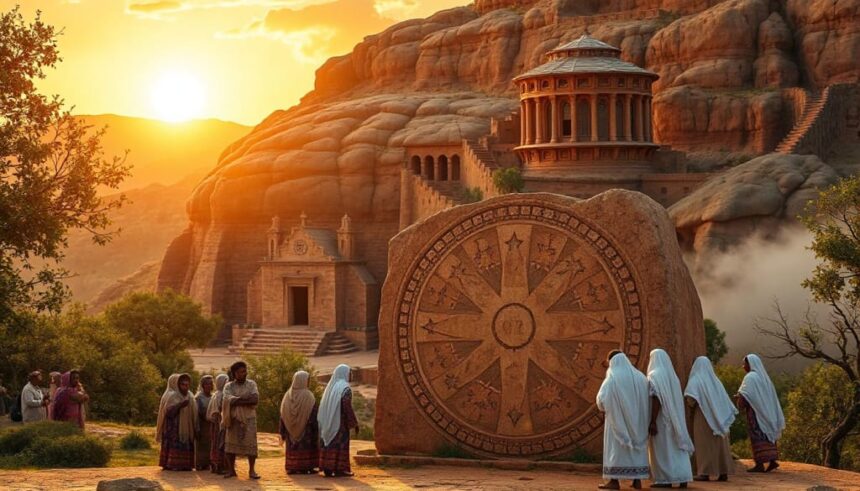
Across the country, time feels layered. Rock-hewn churches carved into the earth at Lalibela. Centuries-old monasteries perched on cliffs. Oral histories and manuscripts that remember events far beyond written timelines. Even legends, such as the belief that the Ark of the Covenant rests in Axum, exist not as myths of the past, but as living elements of the present.
Not behind, just rooted
Ethiopia is not out of sync with the world. It is simply keeping time on its own terms.
In a modern age obsessed with speed, deadlines, and constant acceleration, the Ethiopian calendar offers a quieter perspective. One where time is cyclical, connected to faith and nature, and shaped by continuity rather than change.
So yes, this may be 2026 where you are. But in Ethiopia, it is 2018.
And time, here, is not lost. It is remembered.