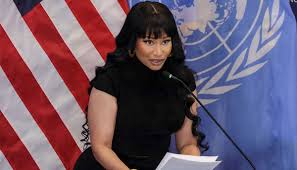
International rapper Nicki Minaj has used a high-profile event at the United States Mission to the United Nations to call global attention to rising violence against Christians in Nigeria, a move that has generated both praise and controversy at home and abroad.
Minaj appeared alongside U.S. Ambassador Mike Waltz, a political ally of former U.S. President Donald Trump, where she described attacks on Christian communities in Nigeria as “a crisis demanding urgent global action.” The event, held in New York, forms part of a broader campaign by some American conservatives who argue that Nigeria is witnessing religious persecution on a massive scale.
Minaj’s Message: A Call for Protection and Global Unity
In her address, Minaj said she felt compelled to speak out after learning about repeated attacks on churches and Christian villages in parts of the country. “Families are being torn apart simply because of how they pray,” she said, urging the international community to defend Nigerians facing violence tied to religious identity.
She also thanked Donald Trump for what she described as his “consistent attention” to alleged anti-Christian violence in Nigeria, a comment that drew immediate scrutiny online. Minaj insisted her remarks were not political, saying her plea was about protecting vulnerable communities, not taking sides in U.S. partisan debates.
Diplomatic Undertones and U.S. Pressure on Nigeria
The event came just weeks after Trump placed Nigeria on a list of “countries of particular concern” over religious freedom, a designation that opens the door to sanctions or other U.S. foreign policy actions. Some allies of the former president have gone as far as suggesting potential military interventions if the situation deteriorates, rhetoric that Nigerian officials have strongly rejected.
Ambassador Waltz, speaking at the same event, accused extremist groups and armed militias in Nigeria of “targeting Christians in coordinated campaigns of violence.” He praised Minaj for “using her global reach to highlight atrocities many governments prefer to ignore.”
Mixed Reactions and Concerns Over Oversimplification
While Minaj’s speech has drawn support from some human-rights groups abroad, it has also triggered a backlash, particularly among Nigerian analysts and international policy experts. Critics argue that the celebrity’s framing risks oversimplifying the country’s complex security landscape.
Security scholars note that while Christian communities have undeniably suffered major attacks, especially in the Middle Belt and parts of the northwest, the drivers of violence include banditry, land disputes, ethnic tensions, and failed governance, not solely religion. Some have accused Minaj of repeating misleading or exaggerated claims that could inflame tensions or distort Nigeria’s image on the world stage.
The Nigerian Context: A Multifaceted Security Crisis
Nigeria has faced escalating insecurity over the past decade, from deadly farmer-herder clashes, to banditry in the northwest, to insurgency in the northeast. Churches have been attacked, but so have mosques, schools, markets, and transport corridors.
Analysts emphasize that both Christian and Muslim communities have suffered, depending on the region and type of violence. Minaj’s speech, they argue, must be viewed against this broader context.
A Celebrity Spotlight With Real Diplomatic Impact
What is clear is that Minaj’s involvement has pushed Nigeria’s internal security challenges into international headlines once again. With over 200 million social media followers, her comments carry influence far beyond traditional diplomatic circles.
For Nigerian officials and for communities directly affected by violence, the attention brings both opportunities and risks: opportunities to spotlight humanitarian suffering, and risks of narratives that may distort complex realities.
As Nigeria continues battling insecurity across multiple fronts, Minaj’s intervention has added a new global dimension to a struggle that remains deeply rooted at home.