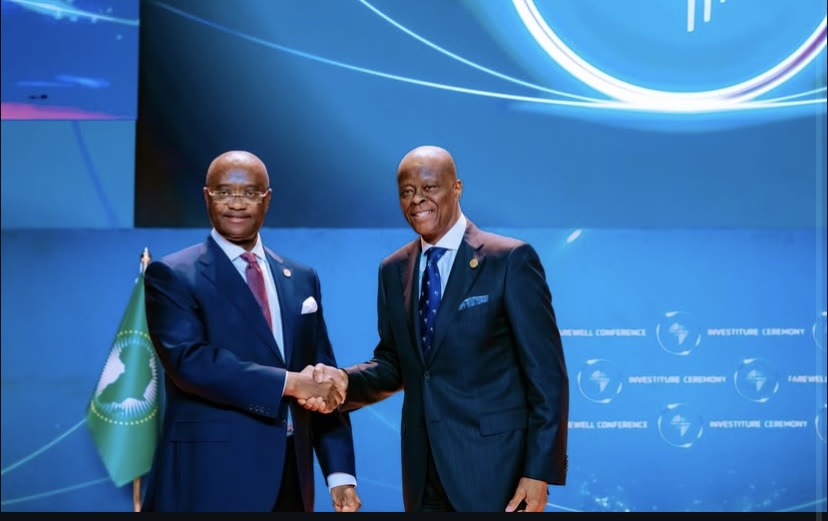
Nigeria on Monday took the global spotlight as it presided over a historic leadership handover ceremony at the African Export-Import Bank (Afreximbank) in Cairo, Egypt, marking a significant milestone in the continent’s economic integration and trade development journey.
The event, which brought together African finance ministers, central bank governors, diplomats, and business leaders, underscored the growing influence of Nigeria within Africa’s financial ecosystem and its continuing leadership in driving continental trade policies through the African Continental Free Trade Area (AfCFTA) framework.
The high-profile ceremony in Cairo saw the official handover of Afreximbank’s top leadership following the completion of the previous president’s tenure. The transition, attended by representatives from over 40 African nations, symbolized continuity, collaboration, and the bank’s enduring mission to accelerate trade and industrialization across the continent.
Representing President Bola Ahmed Tinubu, Nigeria’s Minister of Finance and Coordinating Minister of the Economy, Wale Edun, presided over the proceedings. Edun praised Afreximbank’s contributions to Africa’s economic growth, particularly its support for trade finance, infrastructure funding, and post-pandemic economic recovery programs.
“This handover marks not only a change in leadership but also a reaffirmation of our collective resolve to make African trade self-sustaining,” Edun said. “Afreximbank has been instrumental in shaping the vision of a unified African market, and Nigeria is proud to be part of this transformative journey.”
Founded in 1993, the African Export-Import Bank has grown into one of Africa’s most critical financial institutions, providing billions of dollars in credit lines, trade finance, and infrastructure loans to member countries.
In recent years, Afreximbank has played a key role in:
- Funding major intra-African trade projects,
- Supporting local manufacturing and export diversification, and
- Financing strategic infrastructure, such as ports, refineries, and digital trade systems.
Its leadership handover in Cairo was described as a “moment of renewal” for the institution, which continues to anchor Africa’s response to global economic challenges and strengthen the continent’s financial independence.
Nigeria’s prominent role in presiding over the event highlights its increasing importance as a stabilizing force in African financial diplomacy. Over the past year, Nigeria has deepened its collaboration with Afreximbank through initiatives aimed at enhancing export credit, agro-industrial processing, and energy investments.
The DMO and Nigerian Export-Import Bank (NEXIM) have also worked closely with Afreximbank on multi-billion-dollar facilities to boost local industry and non-oil exports.
According to Edun, “Nigeria’s commitment to economic transformation aligns with Afreximbank’s mission. Our goal is to create jobs, enhance manufacturing capacity, and promote sustainable trade across Africa.”
He further emphasized that the government remains focused on promoting investment partnerships through transparency and robust fiscal reforms.
Several dignitaries in attendance commended the bank’s leadership for fostering economic resilience amid global uncertainties. The outgoing president, in his farewell address, expressed gratitude to member nations and stakeholders for their support, noting that “the next decade must be about deepening African industrialization and ensuring that our economies can compete globally.”
The incoming leadership, meanwhile, pledged to sustain the institution’s achievements while expanding access to trade finance for small and medium enterprises (SMEs) often considered the backbone of African commerce.
Afreximbank’s role is expected to become even more crucial as Africa implements the AfCFTA, which aims to create a single continental market for goods and services covering over 1.3 billion people and a combined GDP exceeding $3.4 trillion.
Experts say the leadership transition comes at a time when African economies are seeking homegrown financial solutions to currency crises, debt restructuring, and infrastructure gaps.
A trade economist, described the Cairo event as “a pivotal moment for Africa’s self-reliance.”
“Nigeria’s involvement at this level sends a strong signal that Africa’s largest economy is ready to lead by example not just in politics, but in practical economic development,” she said.
Beyond Africa, the leadership handover attracted attention from international partners and institutions. The African Union, World Bank, and African Development Bank (AfDB) all issued congratulatory messages, highlighting Afreximbank’s expanding global partnerships and impact.
The bank’s role in creating the Pan-African Payment and Settlement System (PAPSS) a platform designed to facilitate intra-African trade in local currencies was also commended as a groundbreaking step toward reducing dependency on external currencies like the U.S. dollar.
The 2025 Afreximbank leadership handover in Cairo, presided over by Nigeria, will be remembered as a defining moment for African finance one that reaffirmed the continent’s shared vision of prosperity and independence.
As Nigeria continues to play a leading role in regional cooperation and trade, the ceremony stands as a reminder that Africa’s future lies in partnership, innovation, and unity.
“The story of Afreximbank,” Edun said in his closing remarks, “is the story of Africa’s resilience proof that when we act together, we rise together.”