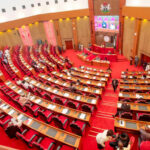
Twenty-three United Nations member states under the auspices of the United Nations Office for Outer Space Affairs (UNOOSA) have convened in Abuja to explore strategies and tools for improving data acquisition, monitoring, and forecasting of space weather.
The event, a five-day international workshop jointly organized by UNOOSA and Nigeria’s National Space Research and Development Agency (NASRDA) under the International Space Weather Initiative (ISWI), focuses on “Space Weather During a Moderate Solar Cycle 25.”
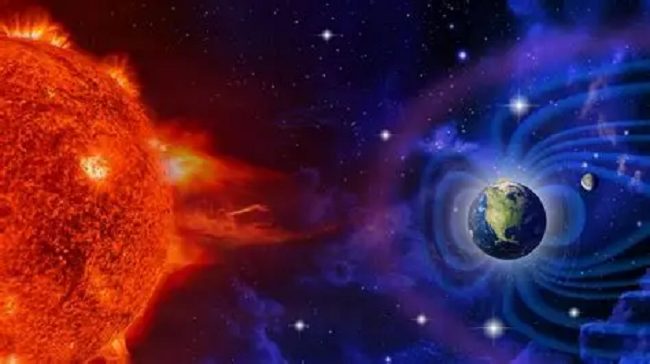
Experts describe a moderate solar cycle as a period of relatively low—though not minimal—solar activity, characterized by moderate sunspot numbers and fewer solar flares and coronal mass ejections (CMEs). Such activity can still trigger occasional geomagnetic storms that may disrupt aviation communication, power grids, and Global Positioning Systems (GPS).
Read Also:
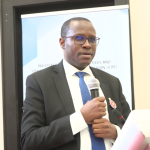
Speaking during the opening session, Ms. Sharafat Gadimova of UNOOSA, Austria, said the agency supports member states in developing capabilities for space weather monitoring as part of broader efforts to strengthen global space activities.
“The international community will explore strategies to improve the collection and exchange of space weather data, modelling, and forecasting methods to enhance accuracy, reliability, and interoperability,” Gadimova said.
“This community will also design a platform to identify user requirements and promote synergy between different communities addressing space weather impact. These activities will support capacity building, training, and initiatives providing cutting-edge information on space weather research,” she added.
On his part, the Director-General of NASRDA, Dr. Matthew Adepoju, stressed that space weather was a global phenomenon requiring coordinated international action, as its effects increasingly impact technological infrastructure both on Earth and in orbit.
Representing the Federal Ministry of Innovation, Science and Technology, Adepoju also used the platform to draw attention to the need for global collaboration in tackling extreme weather conditions such as hurricanes that affect parts of Africa.
“I will use this opportunity to call the attention of global experts on the ISWI platform to the paradigm shift that is needed to address the root causes of extreme weather impacts,” he said.
“It is of note that extreme weather conditions, usually expressed as hurricanes and originating largely from the Sahara Desert, have caused significant damage to properties and lives across the Atlantic Ocean.
We need to join hands to ensure programmes such as the Great Green Wall succeed in addressing the causes of these disasters,” Adepoju added.
The workshop aims to deepen scientific collaboration, promote data-sharing frameworks, and enhance the global capacity to predict and mitigate space and extreme weather impacts on technology and human life.