President Bola Ahmed Tinubu has explained that the ₦200 billion intervention fund established by his administration for micro, small, and medium enterprises (MSMEs) and manufacturers was designed to boost competitiveness and address structural challenges within Nigeria’s economy.
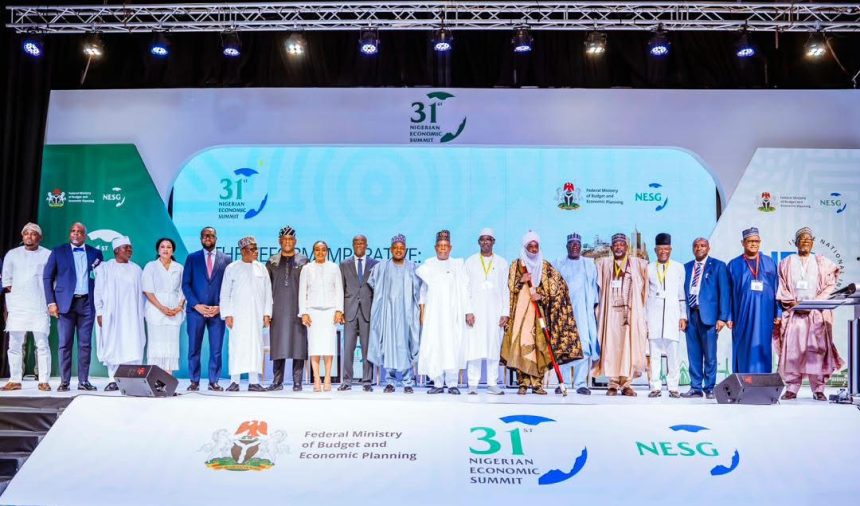
Speaking in Abuja on Monday at the opening of the 31st Nigerian Economic Summit, the President ably represented by Vice President Kashim Shettima, said the decision to set up the fund was guided by the need to balance economic logic with public expectations amid ongoing national reforms.
He added that the initiative reflects his administration’s commitment to creating opportunities for young Nigerians, supporting small businesses, and building a more inclusive economy.
“As a people-oriented government, our priority remains restoring hope to the unemployed, the poor, the excluded, and the vulnerable,” he said. “We established a ₦200 billion intervention fund to support micro, small, and medium enterprises and manufacturers, helping them overcome structural challenges and enhance competitiveness.
“We have also expanded access to digital micro-loans to promote financial inclusion, empower small businesses, and stimulate productivity at the community level. These efforts underline our commitment to an economy that works for all Nigerians.”
He said his administration’s reforms were already yielding results, citing Nigeria’s GDP growth rate of 4.23 per cent in September 2025—higher than projections by both local and international experts. He noted that revenue collection rose from ₦19.9 trillion in 2023 to ₦27.8 trillion as of August 2025, surpassing the year’s target.
Subsequently, he narrated that Nigeria’s debt service-to-revenue ratio had dropped to less than 50 per cent from 97 per cent in 2023, a development that recently led Fitch and Moody’s to upgrade the country’s credit ratings.
“The stability in our foreign exchange market is not accidental; it reflects deliberate choices guided by economic wisdom,” he said. “Along with subsidy removal, these decisions have rescued our public finances, stabilised the economy, and reassured investors at home and abroad. We owe this progress to the sacrifices of Nigerians, whose patience has been the bedrock of our endurance.”
The President said non-oil revenues had grown by 411 per cent year-on-year as of August 2025, with the country’s tax-to-GDP ratio now at 13.5 per cent—almost double what it was a few years ago. He also reaffirmed that the administration’s new tax reforms would simplify compliance, boost domestic revenue, and protect low-income earners.
Furthermore, he explained that increasing monthly federal allocations to states was part of efforts to empower subnational governments to fund critical projects and social interventions.
“I came into office fully aware that the secret to a successful federation lies in empowering each federating unit with the resources and autonomy to pursue development peculiar to its needs,” he added.
Earlier, Minister of Budget and Economic Planning, Senator Atiku Bagudu, commended the partnership between the ministry and the Nigerian Economic Summit Group (NESG), noting that it had helped drive reforms and strengthen collaboration between the public and private sectors for over 30 years.
NESG Chairman, Mr. Olaniyi Yusuf, called for urgent action to address insecurity as a key enabler of economic reform, while Vice Chairman, Mr. Boye Olusanya, described the Tinubu administration’s fiscal and monetary reforms as “bold and strategic,” warning that reversing them could slow economic progress.
Dignitaries at the event included the Coordinating Minister of Finance and the Economy, Wale Edun; Minister of Trade, Industry and Investment, Dr. Jumoke Oduwole; Minister of Agriculture and Food Security, Senator Abubakar Kyari; and Minister of Communications and Digital Economy, Bosun Tijjani.