By Aisha Muhammad Magaji
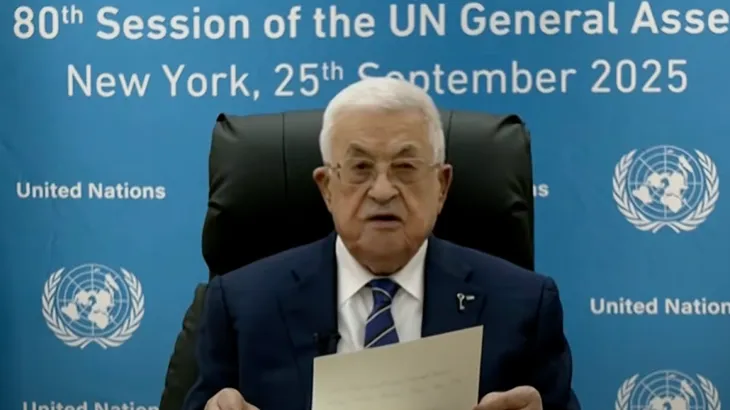
Palestinian Authority President Mahmoud Abbas delivered a defiant address to the 80th United Nations General Assembly on Thursday, demanding an immediate ceasefire in Gaza while ruling out any future role for Hamas in Palestinian governance.
Speaking via video link after being denied a U.S. visa, Abbas accused Israel of waging “a war of aggression, genocide, and crimes against humanity” in Gaza. He said: “These crimes are documented and will remain a stain on history. The world cannot turn a blind eye while Palestinians are being massacred.”
Abbas called for urgent humanitarian access to Gaza, insisting that “every hour of delay costs lives.”
On internal politics, the Palestinian leader made it clear that Hamas would not be part of a postwar Palestine. “Hamas and all armed factions must hand over their weapons. The Palestinian Authority is ready to assume full responsibility for governance and security in Gaza,” he declared.
The remarks were quickly rejected by Hamas, which accused Abbas of “siding with the occupier,” but observers noted that the statement was aimed at reassuring international partners that Gaza would not remain under militant control.
Abbas also renewed his push for full United Nations membership for Palestine, pointing out that more than 140 countries already recognize its statehood. “There will be no peace without justice, and no justice without the liberation of Palestine,” he said.
The Palestinian president criticized Israel’s settlement expansion in the West Bank, warning that it threatens the two-state solution. “Every new settlement is a violation of international law and a blow to the prospects of peace,” Abbas argued.
Addressing concerns about leadership and governance, Abbas pledged sweeping reforms once the war ends. He promised to hold presidential and parliamentary elections within a year, draft a temporary constitution in three months, reform school curricula to meet UNESCO standards, and overhaul welfare programs to improve transparency.
Despite the devastation in Gaza, Abbas struck a note of resilience. “Our people will rise from under the rubble to rebuild, just as olive trees rise from the ashes,” he said, reaffirming that Jerusalem remains the “eternal capital of Palestine.”
His speech drew a mixed response at the UN. Arab and African leaders welcomed his call for statehood recognition, while Israel dismissed the address as “empty rhetoric.” Analysts said Abbas was seeking to reassert the Palestinian Authority’s legitimacy at a time of political fragmentation.
“Abbas wants the world to see the PA, not Hamas, as the credible voice of Palestine,” said Dr. Lina Haddad, a Middle East analyst. “But without internal unity, his message may struggle to resonate.”
At UNGA 2025, Abbas’s message was clear: Palestine seeks sovereignty, reform, and international recognition but not with Hamas in the picture.