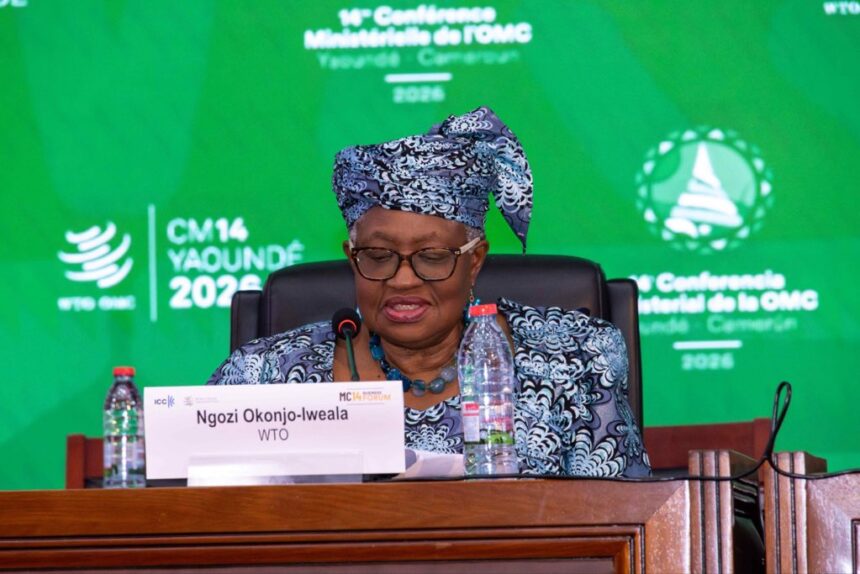
The Director-General of the World Trade Organization Ngozi Okonjo-Iweala issued a stark warning that the global trade system has undergone irreversible change, signaling a major shift in how countries engage in international commerce.
Speaking in Youndé, Cameroon on March 26, 2026, Okonjo-Iweala described the current state of global trade as facing its “worst disruption in 80 years,” raising concerns over the future of multilateral cooperation.
In her remarks, the WTO chief emphasized that the traditional global trade framework which has governed international trade relations for decades may not return in its previous form.
“The global trade order has irrevocably changed,” she said, warning that the multilateral system as previously known is unlikely to be restored.
The statement underscores growing concerns among economists and policymakers about the weakening of global institutions and the rise of protectionist policies across major economies.
Experts point to several key factors behind the ongoing transformation of global trade:
Geopolitical tensions between major world powers,Supply chain disruptions following global crises,Economic nationalism and protectionist policies,Shifts in manufacturing and trade alliances.
These developments have gradually eroded the stability of the multilateral trading system traditionally overseen by the WTO.
Okonjo-Iweala called on countries to take proactive steps in reforming global trade rules to reflect current realities.
She stressed the need for: Modernized trade frameworks,Inclusive policies for developing nations,Stronger cooperation mechanisms.
According to her, failure to adapt could further destabilize global markets and widen economic inequalities between nations.
The warning carries significant implications for developing countries, including Nigeria,which rely heavily on stable global trade systems for exports, imports, and economic growth.
Analysts say disruptions in global trade could:
Increase the cost of goods and services, Affect foreign exchange stability, Disrupt supply chains,Limit access to international markets.
For African economies, the shift could also redefine trade partnerships and accelerate regional trade agreements such as the African Continental Free Trade Area (AfCFTA).
The WTO chief’s remarks highlight what many experts see as a turning point in global economic history a transition from a rules-based multilateral system to a more fragmented and regionally driven trade environment.
While some countries may benefit from new alliances and localized supply chains, others risk being left behind without adequate reforms and strategic positioning.
Ngozi Okonjo-Iweala’s warning signals a critical moment for global trade. As the world navigates unprecedented economic shifts, the call for reform is not just urgent but necessary.
Whether nations can come together to rebuild a more resilient and inclusive trade system remains uncertain but one thing is clear, the old global trade order may no longer exist.