In what appears to be another dent in the credibility of federal recruitment processes, the recently released shortlist for the 2025 Nigeria Customs Service (NCS) Superintendent Cadre has stirred outrage across the country. The figures tell a story not of merit or inclusivity, but of regional bias and ethnocentric governance that questions the administration’s commitment to fairness and unity.
President Bola Ahmed Tinubu’s government is once again under public scrutiny this time over allegations of favoritism that seem to privilege his political base at the expense of national balance.
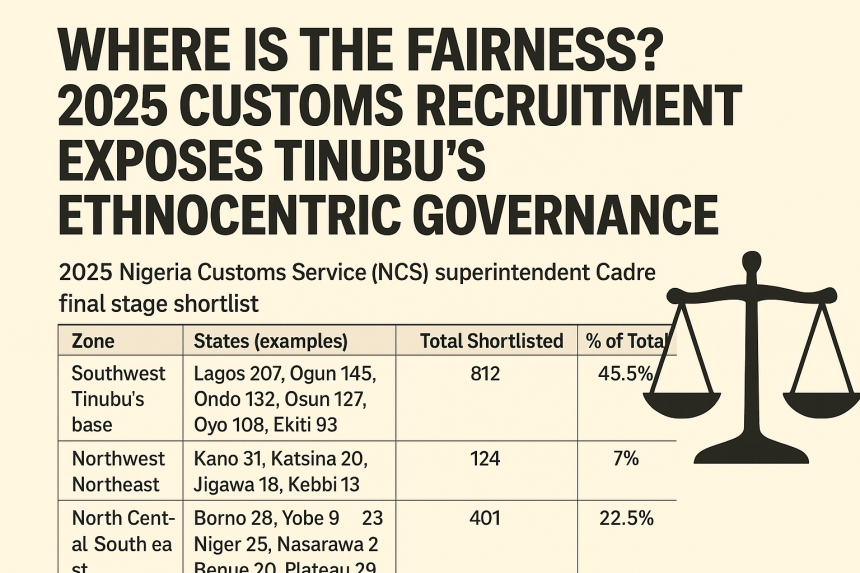
The NCS released a total of 1,785 shortlisted candidates for the Superintendent Cadre’s final recruitment stage. However, a closer look at the state-by-state breakdown reveals a troubling trend a concentration of opportunities within the Southwest region, particularly in states aligned with the President’s geopolitical zone.
According to available data, here’s how the shortlist looks by region:
| Zone | Selected States (Examples) | Total Shortlisted | % of Total |
| Southwest (Tinubu’s Base) | Lagos 207, Ogun 145, Ondo 132, Osun 127, Oyo 108, Ekiti 93 | 812 | ≈45.5% |
| Northwest | Kano 31, Katsina 20, Jigawa 18, Kebbi 13, Sokoto 28, Zamfara 16 | 126 | ≈7% |
| Northeast | Borno 38, Yobe 9, Adamawa 23, Bauchi 21, Gombe 16, Taraba 17 | 124 | ≈7% |
| North Central | Kwara 173, Kogi 78, Niger 25, Nasarawa 28, Benue 20, Plateau 29, FCT 48 | 401 | ≈22.5% |
| South-South & Southeast | Delta 28, Edo 29, Bayelsa 36, Cross River 28, Rivers 27, Enugu 28, Anambra 28, Imo 13, Abia 28, Ebonyi 20, Akwa Ibom 29 |
When measured against population density, youth unemployment, and educational spread, the disparity becomes glaring.
For instance, Yobe, Jigawa, Taraba, Gombe, and Zamfara combined all heavily populated and youth-dominated states received fewer slots than Lagos State alone. This is not reflective of the federal character principle enshrined in Nigeria’s Constitution.
Rather, it reflects an emerging pattern where political geography and loyalty seem to determine access to national opportunities.
The Customs Service, like every federal agency, is meant to embody national representation and serve as a model of equity. However, the figures suggest that recruitment has once again fallen prey to regional dominance and elite capture.
Many Nigerians are asking:
What message does this send to millions of unemployed youths across northern and eastern Nigeria?
That merit no longer matters? That the system now rewards where one comes from rather than what one can contribute?
Analysts warn that such lopsided recruitment exercises risk deepening existing divisions and undermining national unity. “When young people see that their opportunities are limited not by ability but by origin, the bond of citizenship weakens,” said a public affairs commentator who preferred not to be named.
The implications extend beyond the Customs Service they cut to the very foundation of trust in public institutions.
The Federal Character Commission (FCC) and the National Assembly Committees on Public Service and Federal Character must urgently intervene to restore public confidence. Nigerians deserve transparency.
Three key questions demand answers:
- What criteria were used to determine the shortlist?
- Who approved the distribution, and was it subjected to federal character review?
- How can the process be corrected before the final selection?
Until these questions are answered, the perception of institutionalized bias will persist and so will the frustration of marginalized Nigerians who feel shut out of national service opportunities.
Critics argue that this Customs recruitment saga is only a symptom of a broader governance problem under the Tinubu administration. From strategic appointments to resource allocations, there’s a growing sense that ethnic favoritism is quietly replacing the long-held principle of “unity in diversity.”
While supporters of the administration insist that competence and regional representation are being balanced, the numbers in the Customs recruitment list suggest otherwise.
A political analyst told S24 Media that: “What we’re seeing is not an isolated case but a deliberate pattern of power consolidation. Every major institution seems to be tilting towards the Southwest. If this continues, it will erode the federal structure that keeps Nigeria together.”
The Constitution’s Section 14(3) explicitly provides that the composition of the government and its agencies should reflect the federal character of Nigeria to promote national unity and prevent dominance by any group. The Customs shortlist, critics argue, blatantly violates this spirit.
Beyond politics, this issue touches the heart of governance fairness. The Customs Service is funded by all Nigerians, and its workforce must represent all Nigerians.
If recruitment continues to favour one region, others will feel alienated. That alienation breeds resentment, and resentment, in turn, fuels the very instability that no government can manage with propaganda or promises.
Every federal recruitment exercise under this administration must therefore undergo independent scrutiny, not just to ensure fairness, but to preserve faith in the Nigerian project itself.
When fairness dies, unity dies with it.
As the outrage continues to grow, Nigerians are watching and waiting to see whether justice will prevail, or whether silence will once again be the government’s answer to inequality.