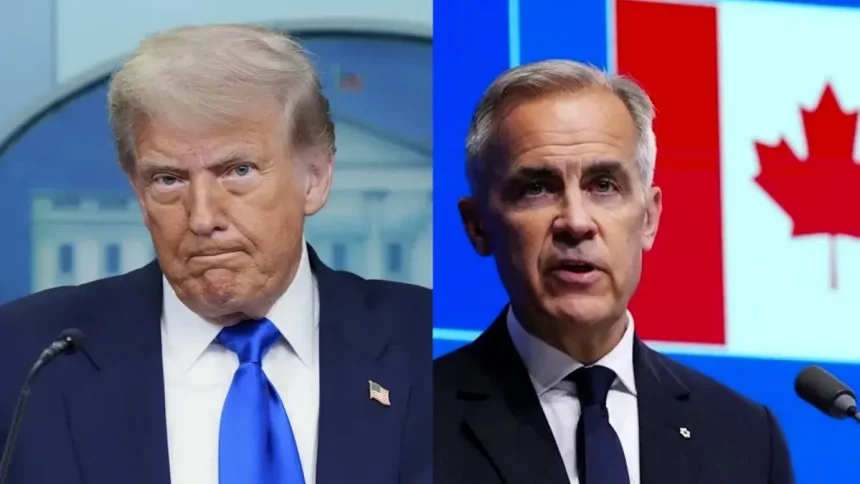
In a move that has sent shockwaves through North American trade and diplomatic circles, former U.S. President Donald Trump has announced the immediate termination of all ongoing trade talks with Canada, citing what he described as “unfair trade practices” and “broken commitments” by the Canadian government.
Speaking during a rally in Ohio, Trump declared, “Canada has taken advantage of the United States for far too long. We are ending all trade negotiations with them effective immediately. The American worker deserves better.”
The announcement, though expected by some of his closest allies, marks a significant escalation in Trump’s long-standing criticism of Canada’s trade policies, particularly under Prime Minister Justin Trudeau’s administration.
According to U.S. media outlets, the talks in question were part of a broader framework aimed at revisiting post-NAFTA (North American Free Trade Agreement) trade arrangements discussions that had continued even after Trump left the presidency.
Economists and political observers say the decision could have wide-reaching implications. Canada remains one of the United States’ largest trading partners, with annual trade exceeding $700 billion. Key sectors affected could include automotive manufacturing, agriculture, energy, and technology.
“Halting negotiations doesn’t just hurt Canada; it affects the entire North American supply chain,” said Dr. Emily Harper, a trade policy expert at the Brookings Institution. “Businesses that depend on cross-border logistics and cooperation will feel the pressure immediately.”
Canadian officials have so far responded cautiously. A spokesperson for Prime Minister Trudeau’s office said, “Canada remains committed to fair trade based on mutual respect. We will continue to protect our economic interests and the livelihoods of Canadians.”
However, insiders at Ottawa’s Department of Global Affairs expressed frustration, noting that the abrupt decision undermines months of technical talks aimed at resolving tariffs, border issues, and digital trade regulations.
Trump’s renewed attack on Canada echoes his “America First” economic philosophy, which defined much of his presidency. During his tenure, he renegotiated NAFTA into the USMCA (United States-Mexico-Canada Agreement), often accusing Canada of manipulating trade rules to America’s disadvantage.
He particularly targeted Canada’s dairy and lumber industries, calling them “disasters for American farmers and workers.” His latest comments suggest a continuation of that sentiment, despite the relative calm that had returned to trade relations in recent years.
Political analysts believe Trump’s move may also be driven by electoral motives, as he seeks to appeal to his base ahead of another potential run for office. “This is vintage Trump,” said political analyst Rick Sanchez. “He’s using economic nationalism to rally his supporters and project strength on international issues.”
Financial markets reacted cautiously following the announcement. The Canadian dollar (CAD) dipped slightly against the U.S. dollar (USD), while energy stocks — particularly those tied to cross-border oil pipelines saw brief volatility.
Trade associations across both countries have urged restraint. The U.S. Chamber of Commerce released a statement saying, “Trade between the United States and Canada supports millions of jobs on both sides of the border. We encourage continued dialogue to prevent unnecessary disruption.”
Meanwhile, Canada’s Business Council warned that a prolonged freeze in talks could hinder investment confidence, particularly in industries already reeling from inflation and supply chain constraints.
While Trump’s words carry no official policy weight given that he currently holds no office his influence over U.S. political discourse remains undeniable. Many fear that if his views gain traction among lawmakers or future policymakers, the already fragile trade balance could suffer a severe setback.
Professor Nathaniel Ross of the University of Toronto commented, “This rhetoric may reawaken protectionist tendencies in the U.S. political class. Even symbolic statements from Trump can influence corporate and diplomatic decisions.”
At the moment, Canada’s strategy appears to be one of caution and resilience. Trudeau’s government is expected to seek reassurances from Washington, possibly through diplomatic channels and the USMCA’s dispute resolution framework.
“Canada will not be intimidated,” said a senior Canadian diplomat who spoke anonymously. “Our trade relationship with the U.S. is built on decades of partnership, not personal politics.”
The Trump-Trudeau relationship has long been fraught with tension — from the 2018 G7 summit standoff to repeated Twitter exchanges over tariffs and trade deals. Today’s announcement adds another chapter to that strained history.
If the suspension of trade talks persists, experts warn of broader consequences for North American cooperation, including energy security, border management, and environmental policy alignment.
As one former Canadian ambassador put it, “When America sneezes, Canada catches a cold and right now, it looks like we’re facing a trade fever all over again.”