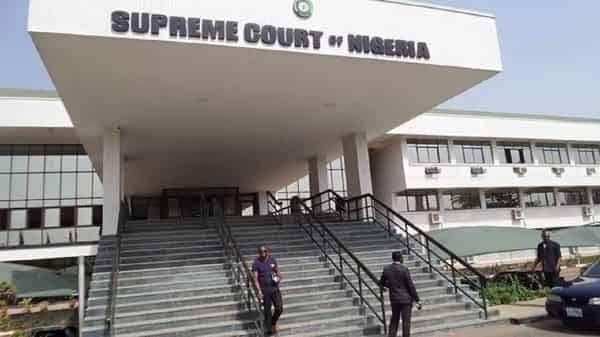
The Supreme Court has affirmed the constitutional authority of the President to declare a state of emergency in any state threatened by a breakdown of law and order, including the power to temporarily suspend elected officials as an extraordinary measure to restore stability.
The apex court delivered the ruling in a 6–1 split decision by a seven-man panel of justices in a suit filed by Adamawa State and 10 others, challenging President Bola Ahmed Tinubu’s March 18, 2025 declaration of emergency rule in Rivers State.
The emergency proclamation resulted in the six-month suspension of the Rivers State Governor, Deputy Governor, and members of the State House of Assembly following a prolonged political crisis and security concerns.
Although the Supreme Court initially dismissed the suit on jurisdictional grounds, holding that the plaintiffs failed to establish a sufficient cause of action to invoke its original jurisdiction, the court proceeded to address the substantive constitutional issues for guidance and clarity.
In the lead judgment delivered by Justice Mohammed Idris, the court held that Section 305 of the 1999 Constitution (as amended) grants the President broad discretionary powers to implement extraordinary measures during emergencies to prevent anarchy and restore public order.
The court ruled that while the Constitution does not explicitly list the actions permitted under emergency rule, it allows temporary suspension of elected officials, provided such actions are time-bound and solely aimed at restoring normal governance.
Justice Idris stated that “the President is vested with the responsibility to protect the Federation, and this includes deploying necessary tools during crises where governance has collapsed.”
In a dissenting opinion, Justice Obande Ogbuinya held that although the President possesses the constitutional authority to declare a state of emergency, such powers do not extend to suspending democratically elected officials.
He warned that suspending governors, deputies, or lawmakers undermines federalism and bypasses the constitutional procedures for removing elected officials from office.