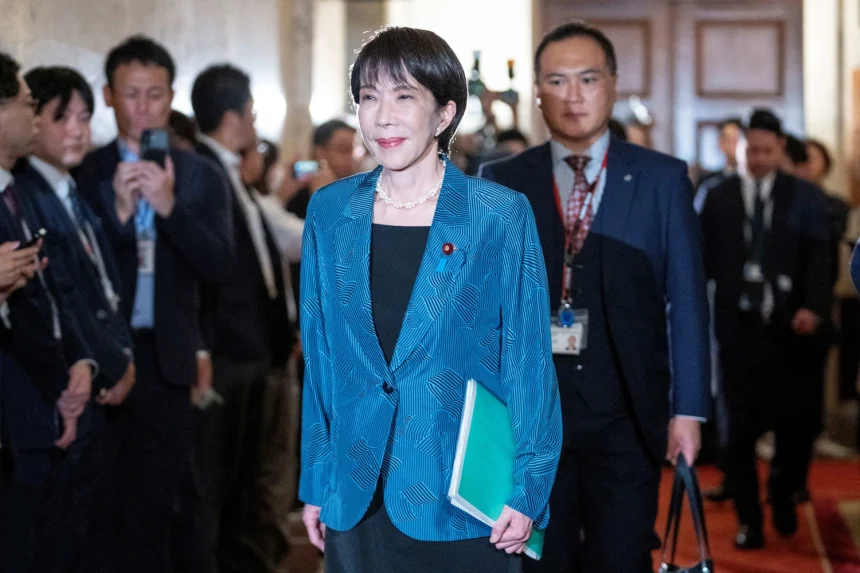
In a landmark moment for Japanese politics, Sanae Takaichi has been elected as the first woman to serve as Prime Minister of Japan, succeeding Shigeru Ishiba and taking office on October 21, 2025.
Takaichi, aged 64, secured the premiership following a vote in the lower house of the Diet in which she earned 237 votes against 149 for opposition candidate Yoshihiko Noda. Her rise comes after she was elected president of the ruling Liberal Democratic Party (LDP) earlier this month and formed a coalition with the Japan Innovation Party (JIP) following the departure of the LDP’s longtime partner, Komeito.
Takaichi has pledged to lead her new government into bold reforms and to steer Japan amid both domestic and international headwinds. “We will work to realize policies that overcome domestic and international challenges, protect the livelihoods of the people and the peace of the nation and strongly advance Japan forward,” the LDP said in its post-election statement.
Despite Japan’s long-standing status as a global economic powerhouse, its politics have remained overwhelmingly male-dominated. Takaichi’s election thus represents a historic glass-ceiling break but also comes with complex baggage.
While she has promised to increase women’s representation in her government, critics note that her first cabinet includes only three women. Moreover, Takaichi opposes reforms such as separate surnames for married couples and female-emperor succession, placing her at odds with broader gender-equality expectations.
Takaichi is a staunch conservative with strong nationalist credentials. She advocates revising Japan’s pacifist constitution, strengthening its Self-Defence Forces, and taking a tougher stance on China and North Korea.
On the economic front, she has embraced the “Abenomics” model of fiscal stimulus and monetary easing, warning that Japan cannot remain passive amid global competition. “Instead of just celebrating, I know the real challenge starts now,” she said after securing the LDP leadership.
Her government also faces immediate diplomatic tasks, including hosting U.S. President Donald Trump and participating in upcoming regional forums, all while managing inflation, an aging population, and sluggish growth.
Takaichi’s coalition holds just 231 seats in the 465-seat lower house and lacks a solid majority in the upper house, giving her limited maneuvering room. This tight margin could complicate efforts to pass major legislation.
Despite this historic win, analysts caution that her ascent may not signal a major shift in gender equality or liberal governance. “Japan broke a barrier,” observed one expert, “but the structural challenges remain.”
Supporters hail the moment as a step forward, with some noting a pensioner’s remark that she is “a strong-minded person, regardless of being a woman.” Others, however, remain skeptical given her conservative positions and narrow power base.
Internationally, observers are watching how Takaichi’s leadership will affect Japan’s regional strategy, defence posture, and relations with allies such as the U.S., as well as with China and South Korea.
As she takes charge as Japan’s 104th prime minister in a male-dominated institution, the real test begins: to convert this symbolic breakthrough into tangible governance and inclusive progress in a country undergoing significant demographic and economic shifts.