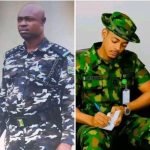
When politics meets khaki, sparks fly and in Abuja’s Gaduwa district on November 11, 2025, the clash between Federal Capital Territory (FCT) Minister Nyesom Wike and Lieutenant Yerima, a naval officer, lit up Nigeria’s civil-military debate.
According to multiple reports, Minister Wike visited a disputed plot of land under FCTA enforcement when naval personnel blocked his access. The officers, led by Lt. Yerima, claimed they were acting on orders to guard the property reportedly linked to a retired Chief of Naval Staff.
The situation quickly turned tense when Wike accused the officers of aiding illegal development, while Yerima insisted he was acting under lawful command. Witnesses said the exchange grew heated, with the minister calling the officer “a big fool” but Yerima stood his ground.
The fallout was immediate as Retired military chiefs condemned Wike’s outburst as a threat to national security and military discipline, while his aides argued that the naval officer was effectively working as a private guard, not performing an official military duty.
The Nigerian Constitution calls on every citizen to respect the nation’s institutions, including the armed forces. The Federal Ministry of Works, summarising constitutional duties, notes that it is a citizen’s responsibility to “abide by the Constitution, respect its ideals, its institutions, and legitimate authorities.” That duty extends to uniformed officers acting lawfully. But this respect is not absolute, it depends on lawful authority. An officer acting outside military mandate or in a private capacity forfeits the immunity of uniformed service.
Nigeria’s Criminal Code reinforces this respect by restricting who may wear military uniforms. Sections 110 and 111 criminalise unauthorised use of military attire, while Section 251 of the Constitution warns against any act likely to “bring contempt on the uniform.” The law protects the integrity of the uniform, but it also limits what it can lawfully represent.
Under Sections 147(2) and 297 of the Constitution, ministers are presidential appointees with delegated executive powers. For the FCT, that means the minister acts on the President’s behalf in matters of land use, planning, and enforcement. Wike, therefore, had legal grounds to inspect and enforce FCT land-use regulations. However, ministerial authority must still follow due process and remain civil. Publicly insulting a uniformed officer, even during enforcement, can be seen as undermining institutional respect as ministers wield power by law, not personality.
The Gaduwa incident sits at the intersection of two authorities: the minister’s statutory duty to enforce land laws and the officer’s duty to obey lawful military orders. If the officer was guarding private property that would be outside military function and Wike’s challenge could be justified. But if the property was under official protection, then the minister’s confrontation may have breached protocol. Both acted under state authority; both may have stretched their powers.
The incident has ignited debates about civil-military relations and the balance of power between elected officials and security institutions. Former service chiefs warn that Wike’s conduct erodes respect for command structures. Supporters counter that unchecked military presence in civilian matters threatens democracy. Either way, the episode exposes a fragile truth: in Nigeria, power and uniform often collide, and when they do, the Constitution, not ego must prevail.
Observers now await possible fallout. Will the FCTA or the military open an inquiry? Could this reshape how security agencies engage in land enforcement? Might either party seek legal redress? Whatever the outcome, one lesson stands clear: the altercation was never just about a plot of land, it was a public test of institutional boundaries. The Constitution gives both civilian leaders and military officers’ authority, but it also binds them to restraint.
In a democracy, law, not temper defines power.