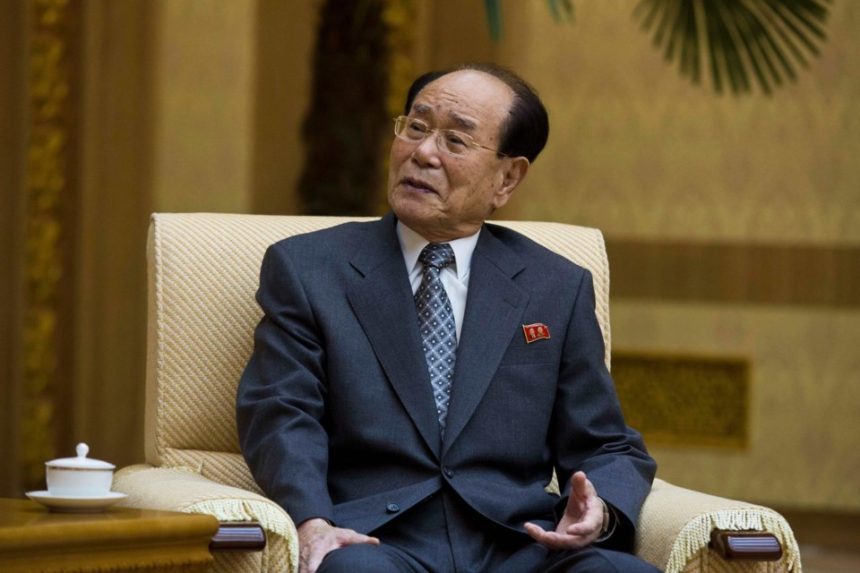
North Korea’s long-serving former ceremonial head of state, Kim Yong Nam, has died at the age of 97, state media announced on Monday.
According to the Korean Central News Agency (KCNA), Kim passed away on November 3 due to multiple organ failure after a battle with colorectal cancer. Leader Kim Jong Un reportedly visited his bier to pay his respects, and a state funeral committee of 100 members, chaired by Kim himself, has been established to oversee the ceremony.
A Lifelong Diplomat
Born in 1928 during Japan’s colonial rule over the Korean Peninsula, Kim Yong Nam was one of North Korea’s most seasoned diplomats. Educated at Kim Il Sung University and later at Moscow State University, he joined the Workers’ Party of Korea in the 1950s and quickly rose through the ranks.
He served as foreign minister from 1983 to 1998, playing a key role in Pyongyang’s foreign relations during the Cold War era. In 1998, he was appointed Chairman of the Presidium of the Supreme People’s Assembly, a role that made him the country’s official head of state, though ultimate power remained with the Kim family dynasty.
Kim held the position for more than 20 years, representing North Korea at major diplomatic events and meetings with foreign leaders. He stepped down in April 2019, succeeded by Choe Ryong Hae.
Representing North Korea Abroad
Although his position was largely ceremonial, Kim was often seen as North Korea’s face to the outside world. He met numerous foreign dignitaries, attended international summits, and led Pyongyang’s delegation to the 2018 PyeongChang Winter Olympics in South Korea, a rare moment of inter-Korean engagement.
Foreign governments have extended condolences following his death. China’s Foreign Ministry described Kim as an “old friend of China who made important contributions to strengthening bilateral ties.” Vietnam and Russia also sent official messages of sympathy.
End of an Era
Kim Yong Nam’s death marks the passing of one of the last senior officials who served under all three generations of North Korea’s leadership, Kim Il Sung, Kim Jong Il, and Kim Jong Un. Analysts say his longevity in the upper echelons of power highlights his diplomatic skill and political caution in a system known for frequent purges.
While his death is not expected to alter the country’s power dynamics, it symbolizes the end of an era for North Korea’s old guard and underscores the ongoing generational shift under Kim Jong Un’s rule.