By Aisha Muhammad Magaji
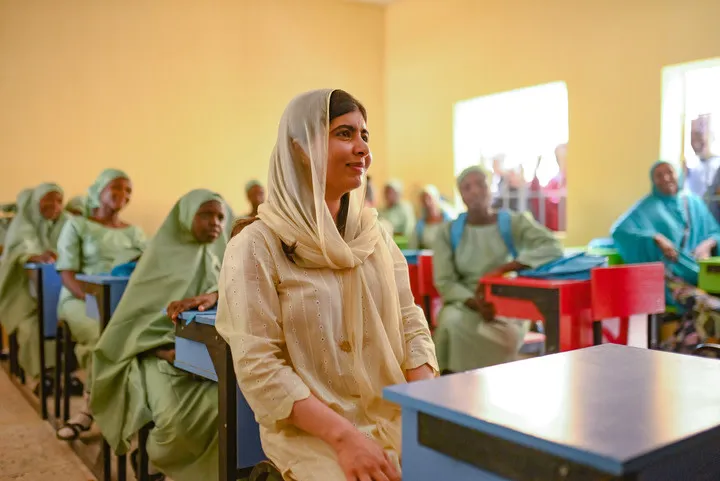
Nobel Peace Prize laureate and global education activist Malala Yousafzai has arrived in Nigeria as part of her ongoing campaign to prioritize girls’ education and push for stronger government and community support for female students.
Malala, who survived an assassination attempt by the Taliban in 2012 and has since become the world’s leading voice for girls’ education, is visiting Nigeria to engage with policymakers, civil society groups, and young advocates.
In Abuja on Monday, she emphasized that Nigeria home to the highest number of out-of-school children in the world must place urgent focus on ensuring girls not only enter school but also complete their education.
“Education is a right, not a privilege,” Malala said during her meeting with government officials. “When girls are educated, societies are safer, families are healthier, and economies are stronger.”
According to the UNICEF Nigeria Education Fact Sheet (2024), about 20 million Nigerian children are out of school, with girls making up 60 percent of this figure. Poverty, child marriage, insecurity, and cultural barriers continue to hinder access to education, particularly in the northern states.
The North-East and North-West regions are the hardest hit due to armed conflict and attacks on schools by insurgents and bandits. Many parents fear sending their daughters to school because of abductions, such as the infamous Chibok (2014) and Dapchi (2018) kidnappings.
During her visit, Malala is scheduled to meet with President Bola Tinubu, state governors, and lawmakers to press for increased budgetary allocations for education, especially in rural and conflict-affected areas.
She also plans to hold dialogues with traditional rulers and religious leaders who play key roles in influencing community attitudes towards girls’ education.
“Community buy-in is as important as government policy. Parents need assurance that schools are safe and that educating their daughters will not compromise cultural values but rather strengthen families,” she said.
Malala also met with Nigerian girls who are part of the Malala Fund’s Education Champions Network, which supports local activists working on innovative solutions to get girls into classrooms.
One of the beneficiaries, 17-year-old Aisha Musa from Borno State, shared her story of resilience after her school was shut down due to insecurity.
“I almost lost hope, but with the help of local NGOs supported by Malala’s fund, I was able to continue my studies. Today, I want to become a teacher so I can inspire other girls,” she said.
Nigeria currently spends less than 10 percent of its national budget on education, far below the UNESCO-recommended 15–20 percent. Malala stressed that without adequate financing, reforms would remain only on paper.
“Teachers must be trained and motivated, classrooms must be built, and learning materials must be available. It is not enough to talk about education; we must invest in it,” she added.
Nigeria is one of the priority countries for the Malala Fund, which operates in more than eight countries, including Pakistan, Ethiopia, and India. The fund focuses on advocating for policy changes, supporting grassroots activists, and amplifying the voices of young women.
The activist’s Nigeria visit comes at a time when global attention on education has intensified, with the United Nations warning in 2025 that the world is off-track to meet the Sustainable Development Goal (SDG 4) of ensuring inclusive and equitable quality education for all by 2030.
Nigerians have welcomed Malala’s visit, with educationists and rights groups describing it as a timely reminder of the urgency of reforms.
An education consultant, said:
“Malala’s presence puts pressure on the government to act. If the world’s youngest Nobel laureate can travel to Nigeria to speak for our girls, what excuse do we have as leaders not to do the same?”
For Malala, Nigeria represents both a challenge and an opportunity. With its large youth population, the country has the potential to become a powerhouse of innovation and growth but only if every child, especially girls, has access to quality education.
As she concluded her Abuja engagement, Malala reiterated her commitment:
“I will continue to stand with Nigerian girls until every one of them is in school, learning, and dreaming without fear. The time to act is now.”