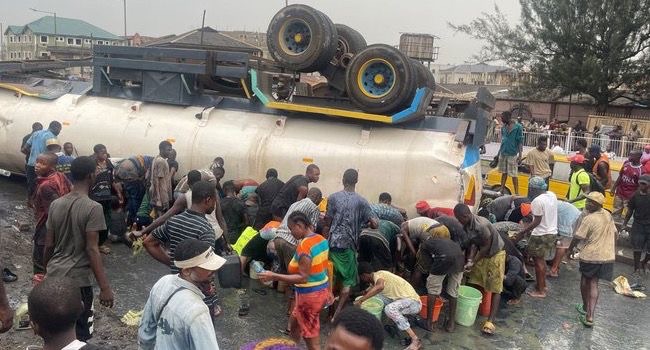
Nigeria was once again reminded of a dangerous culture we keep ignoring. On Monday, a diesel tanker fell at Liverpool Bridge in Apapa, Lagos. Instead of people running away or allowing emergency agencies to do their work, some residents rushed to scoop fuel from the fallen tanker.
The Director-General of the National Orientation Agency (NOA), Lanre Issa-Onilu, strongly condemned the act and called for fuel scooping to be criminalised. According to him, fuel scooping is unacceptable in a modern society because it puts lives at serious risk. He explained that the danger does not only affect those scooping the fuel, but also motorists, nearby communities, emergency responders, and public infrastructure.
Issa-Onilu revealed that despite years of nationwide sensitisation and public awareness campaigns, people still engage in this risky behaviour. He was clear that poverty should never be used as an excuse for actions that can lead to death. He also recalled past tanker accidents where fuel scooping led to massive explosions and the loss of hundreds of lives.
I completely agree with the NOA boss on this issue. As Nigerians, we have seen this tragedy repeat itself too many times. From Lagos to the North, tanker explosions have wiped out families in seconds. Yet, each time it happens, we act surprised, mourn briefly, and then return to the same dangerous behaviour.
Scooping fuel from a fallen tanker is not bravery or survival; it is gambling with death. No amount of fuel is worth a human life. The truth is simple: one spark, one mistake, and lives are gone forever.
Issa-Onilu has now urged the National Assembly to pass a law that clearly criminalises fuel scooping, with strong penalties to deter offenders. I believe this step is necessary. Public education alone is no longer enough. There must be consequences for actions that repeatedly put lives at risk.
The Lagos State Emergency Management Agency also warned people to stay away from the Apapa incident scene, but warnings often come too late when crowds have already gathered.
This is not just a government problem. It is a collective failure. Until we value human life more than momentary gain, these avoidable deaths will continue. We must reject this habit completely.
Human life is priceless. No excuse, no hunger, and no situation justifies standing next to a fallen tanker filled with fuel. It is time we choose sense over risk, and life over loss.