By Zainab Ibrahim
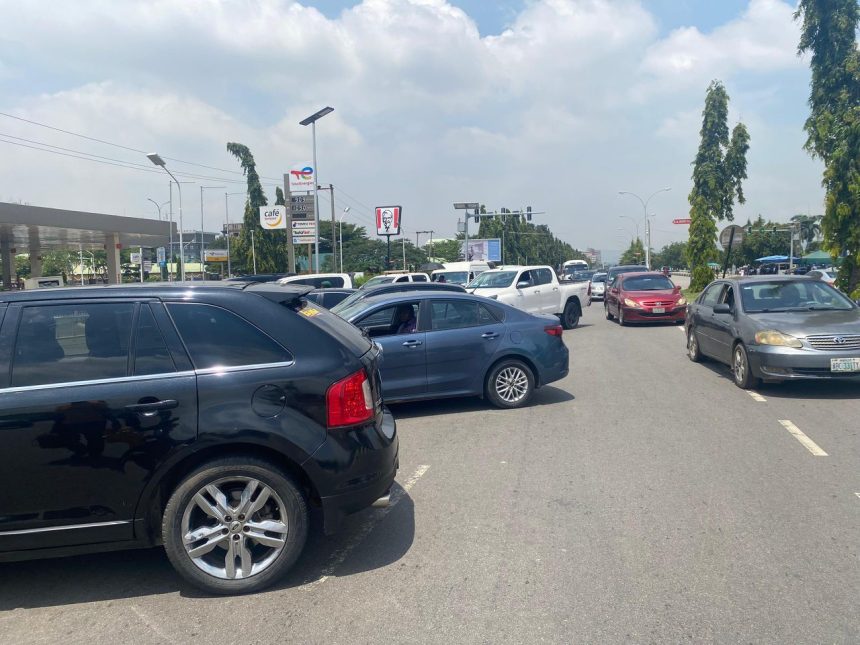
Long queues, frustrated motorists, and closed petrol stations resurfaced on Monday in Abuja, as residents continue to grapple with a worsening fuel scarcity crisis. Across the city, many filling stations are either overwhelmed or completely shut down.
Suleiman Muhammad, a motorist at the Total fueling station headquarters in Asokoro, described the situation as “increasingly embarrassing.” He said, “I searched tirelessly for petrol until my car ran out of fuel. In the end, I had no choice but to turn to the black market just to get enough fuel to move. This situation is unacceptable and needs urgent attention.”
Mr. Enoch, a company driver, shared how the scarcity has lasted over a week, severely disrupting his company’s operations. “I came early hoping I’d get fuel for work today,” he said. “I waited two hours, He noted the long queues were not only frustrating but also unappealing.
Underlying the crisis is a clear disconnect between official assurances and the reality of fuel distribution. Stock levels at many stations remain low due to ongoing supply disruptions, and logistical challenges have hindered the movement of fuel tankers from refineries to depots and stations. In several locations, arriving fuel is sold out within hours, prompting fears of further price hikes and black market profiteering.
Even roadside fuel sellers have expressed confusion. Saidu Umaru said, “We just woke up one morning to find this long queue. We don’t know what is going on. They said they called off the strike, but we are still experiencing this.”
The scarcity has also impacted black market sellers, who are now struggling to source fuel themselves, leading to a doubling of fuel prices on the streets. In many neighborhoods, a liter of petrol now sells for nearly twice the official rate.
Attempts to get information from the Total filling station management in Asokoro were unsuccessful. When requested for comment, an attendant said, “Management is busy.” On approaching the manager, he abruptly walked away.
This lack of communication has only deepened public frustration. Rumors of hoarding and deliberate supply cuts are common but remain unconfirmed. The public continues to ask: Is this a supply or distribution problem or something else entirely?
The fuel scarcity is also having wider ripple effects disrupting public transportation, food supply chains, school attendance, hospital operations, and small businesses that depend on generators. For daily wage earners and small traders, the economic burden continues to mount.
Dangote-PENGASSAN Dispute and Recent Agreement
The current situation comes shortly after an intense labor dispute between the Petroleum and Natural Gas Senior Staff Association of Nigeria (PENGASSAN) and Dangote Refinery. Over 800 workers were reportedly dismissed, allegedly for engaging in union activities and attempting to form a workers’ chapter within the refinery. The dismissed employees had been pushing for improved working conditions, safety standards, and job security.
The standoff prompted a nationwide strike threat, raising fears of broader fuel supply disruptions. However, following government mediation, PENGASSAN announced a truce last week. As part of the agreement, Dangote Refinery committed to reabsorbing the affected workers within the Dangote Group without any loss of pay. The truce brought hope for stability and resumed operations at the refinery.
Yet, despite this resolution, Abuja continues to face a fuel crisis that, on paper, appears resolved but remains unresolved in reality. While the strike may no longer be active, its aftershocks combined with existing logistical issues, poor communication from stakeholders, and distribution bottlenecks continue to leave the city on edge.
Government regulators and the Nigerian Midstream and Downstream Petroleum Regulatory Authority (NMDPRA) are under mounting pressure to provide clear updates, enforce transparency among marketers, and restore normal fuel distribution. For now, Abuja residents wait mostly in line.