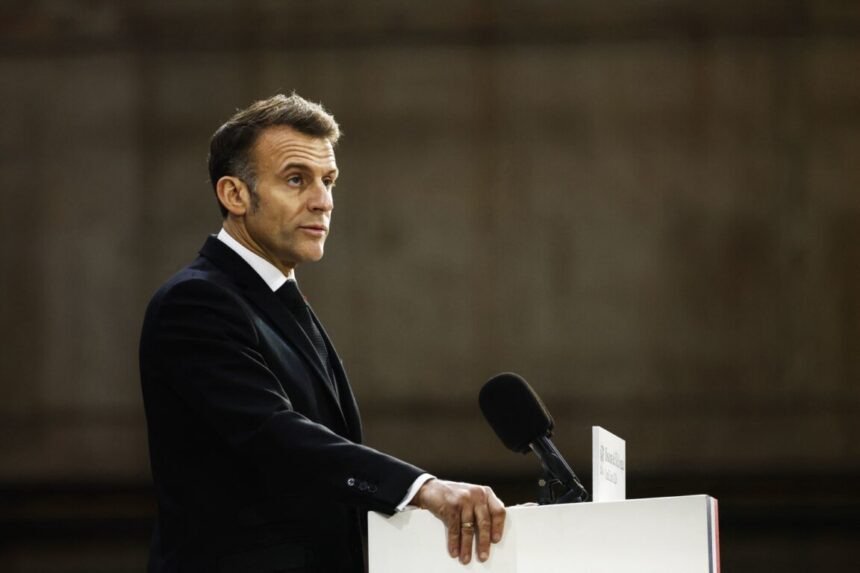
French President Emmanuel Macron has announced plans to expand France’s nuclear arsenal. He also said France could deploy nuclear-armed aircraft to allied European countries for the first time.
Macron unveiled the plan during a speech at the Île Longue nuclear submarine base in north-western France. The proposal aims to strengthen Europe’s security amid rising geopolitical tensions.
According to Macron, eight European countries including Germany, Poland, Sweden and Britain have agreed to participate in what he described as a “forward” nuclear deterrence scheme.
In a joint statement, France and Germany confirmed the creation of a “nuclear steering group.” They stressed that the new arrangement would complement, not replace, NATO’s existing nuclear deterrence framework.
Macron said the initiative would allow allied nations such as the Netherlands, Belgium, Greece and Denmark to temporarily host French strategic air forces.
Response To Global Security Risks
Macron described the current period as one of major geopolitical upheaval. He referenced the ongoing conflict in Ukraine and rising tensions in the Middle East as key concerns.
He also pointed to uncertainty over long-term US commitments under President Donald Trump. Although US officials have reaffirmed NATO’s nuclear protection for Europe, some European leaders remain cautious.
Therefore, Macron said Europe must strengthen its own deterrence capabilities while fully respecting national sovereignty.
France To Maintain Full Control
Despite expanding cooperation, Macron stressed that France would retain exclusive control over nuclear decision-making. He said the forward deterrence plan would operate alongside NATO’s mission but remain separate in structure.
In addition, he ordered an increase in the number of French nuclear warheads. However, he announced that France would no longer disclose details about its stockpile.
France currently maintains the world’s fourth-largest nuclear arsenal, with about 290 warheads. Britain remains the only other European nuclear power.
Political Implications At Home And Abroad
The move comes as European allies watch France’s domestic politics closely. A potential victory by the far-right National Rally party led by Marine Le Pen in next year’s election could alter France’s European commitments.
Security analysts warn that electoral shifts can affect the credibility of nuclear deterrence. Nevertheless, leaders such as Poland’s Prime Minister Donald Tusk and Sweden’s Prime Minister Ulf Kristersson have reacted positively to Macron’s proposal.
While some European leaders continue to call for a world free of nuclear weapons, they argue that deterrence remains necessary as long as nuclear threats persist.