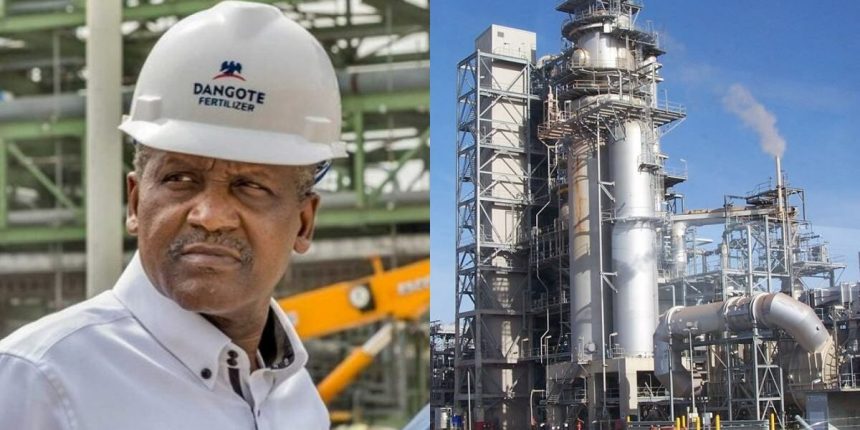
In a major show of confidence in local industrial capacity, the Federal Government of Nigeria has thrown its full support behind the Dangote Refinery as it plans to expand operations to 1.4 million barrels per day (bpd) a move expected to transform the nation’s energy landscape and reduce its dependence on imported refined petroleum products.
This development marks a significant milestone for both the private sector and the country’s oil industry, signaling a united effort toward achieving energy self-sufficiency and economic diversification.
Announcing the government’s backing, officials from the Ministry of Petroleum Resources and the Nigerian National Petroleum Company Limited (NNPCL) described the Dangote Refinery as a “national asset” that would play a central role in reshaping Nigeria’s petroleum economy.
Minister of State for Petroleum Resources (Oil), Heineken Lokpobiri, stated that the government’s partnership with the refinery aligns with President Bola Tinubu’s energy agenda.
“The Federal Government fully supports the Dangote Refinery’s expansion plan. It represents our shared vision to make Nigeria a leading player in Africa’s downstream oil sector,” Lokpobiri said. “We are committed to ensuring it operates at optimal capacity and contributes significantly to job creation, forex savings, and industrial growth.”
NNPCL Group CEO, Mele Kyari, also reaffirmed the corporation’s commitment to ensuring the refinery has access to adequate crude supply and logistical support.
“The refinery has the capacity to change the narrative of our fuel importation dependence,” Kyari noted. “NNPC will continue to collaborate closely with Dangote Group to guarantee steady feedstock supply and efficient market distribution.”
Located in the Lekki Free Trade Zone, Lagos, the $20 billion Dangote Refinery began partial operations earlier this year, with an initial production capacity of 650,000 bpd.
Sources close to the company confirmed that plans are underway to double output to 1.4 million bpd through a phased expansion strategy, with full-scale production expected to commence in 2026.
A senior executive at Dangote Industries Limited described the expansion as a strategic investment that will “not only meet local demand but also position Nigeria as a leading exporter of refined petroleum products across Africa.”
“The goal is to produce premium-grade fuels that meet international standards,” the executive said. “We’re already working with technical partners and regulators to fast-track the expansion phase.”
Analysts say the refinery’s scale-up could save Nigeria billions in foreign exchange annually by cutting down on petroleum imports while providing a stable domestic supply of diesel, aviation fuel, and petrol.
According to the Central Bank of Nigeria (CBN), fuel imports have historically cost the country over $10 billion annually, a figure that could drop sharply once Dangote’s plant operates at full capacity.
Energy economist Dr. Bismarck Rewane said the refinery’s expansion was a timely development in the wake of global oil market uncertainties.
“With output at 1.4 million barrels per day, Nigeria could not only satisfy domestic demand but also dominate the West African refined products market,” Rewane explained. “This will have far-reaching benefits for our balance of trade, employment, and fiscal stability.”
Beyond Nigeria, the Dangote Refinery is expected to play a crucial role in stabilizing fuel supply across Africa, where many countries rely on imports from Europe and Asia.
Experts believe the refinery’s expansion could establish Nigeria as a regional refining hub, boosting continental trade through the African Continental Free Trade Area (AfCFTA) framework.
“An expanded Dangote Refinery means Africa can refine more of its own crude, reducing exposure to global price shocks,” said Dr. Ayo Teriba, CEO of Economic Associates. “It’s one of the most consequential industrial projects on the continent.”
Officials from the refinery emphasized their commitment to environmental standards and sustainability practices as production scales up.
The company said it is investing in modern emission control systems, waste recycling, and energy-efficient technologies, ensuring compliance with both Nigerian and international environmental regulations.
The announcement has sparked optimism among stakeholders, investors, and the public. Nigerians on social media hailed the development as a “turning point” in the country’s industrial journey, while business groups urged the government to maintain policy consistency to encourage further private investment.
The Manufacturers Association of Nigeria (MAN) described the government’s endorsement as “a bold and strategic step toward industrial resilience.”
“We’ve long advocated for local refining capacity,” MAN President Otunba Francis Meshioye said. “Dangote’s progress is proof that Nigerian ingenuity, when supported, can yield global-scale results.”
With full government backing, the Dangote Refinery’s journey toward 1.4 million barrels per day represents more than industrial expansion it embodies Nigeria’s pursuit of self-reliance, energy security, and continental leadership.
As construction progresses and output ramps up, all eyes remain on how this historic collaboration between the private sector and the government will shape the next phase of Nigeria’s economic future.