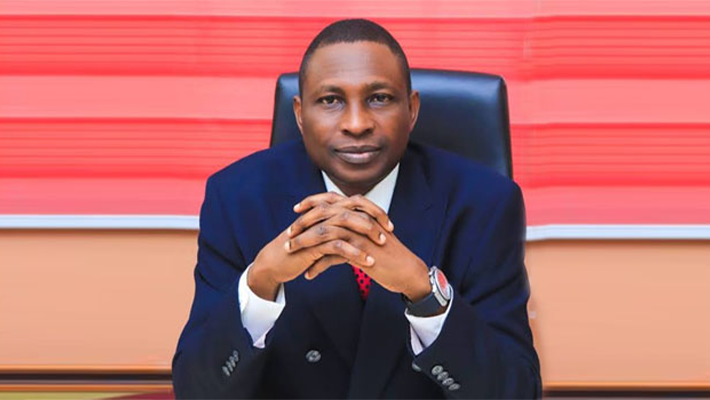
The Chairman of the Economic and Financial Crimes Commission (EFCC), Mr. Ola Olukoyede, has revealed that the agency recovered a total of ₦566 billion in the past two years, marking a major milestone in Nigeria’s fight against corruption and financial crimes.
Olukoyede made this disclosure at a press briefing on Thursday in Abuja, where he presented the EFCC’s performance report and outlined new strategies to combat complex financial offenses.
According to him, the EFCC also recorded over 7,700 convictions within the same period — an achievement he described as “the highest in Nigeria’s anti-corruption history.”
Olukoyede said, “Between 2023 and 2025, the EFCC recovered ₦566 billion in cash and secured 7,700 convictions across different categories of financial crimes. These figures reflect our commitment to ensuring that corruption does not thrive in Nigeria.”
The EFCC boss explained that the recovered funds were proceeds from various cases, including money laundering, contract fraud, cybercrime, and diversion of public funds. He stated that the agency had intensified its investigations into politically exposed persons, government contractors, and corporate organizations involved in fraudulent dealings.
“We have intensified efforts to trace, seize, and return assets looted from the public treasury,” he said. “Our recoveries include not just cash but also properties, vehicles, and foreign currencies hidden in complex networks of shell accounts and offshore holdings.”
Olukoyede emphasized that the EFCC’s forensic laboratories and digital surveillance systems have played a vital role in tracking illicit financial transactions and prosecuting offenders.
The EFCC chairman reassured Nigerians that the commission’s operations remain impartial and guided by the constitution, not politics.
“Our loyalty is to the Nigerian people and the constitution, not to any political interest,” Olukoyede stated. “We are reforming the EFCC into a professional, intelligence-driven, and citizen-centered institution.”
He disclosed that the commission had expanded its reach to address crimes such as cryptocurrency fraud, illegal foreign exchange activities, and oil theft, especially in the Niger Delta.
“Financial crimes today are more sophisticated, and we must evolve to match their complexity. We have strengthened our collaboration with international law enforcement agencies, including INTERPOL, the FBI, and the UK’s National Crime Agency,” he added.
Olukoyede said the EFCC’s record of 7,700 convictions includes both low-level offenders and high-profile cases involving former governors, senior officials, and cybercriminals.
He warned that the agency will continue to clamp down on internet fraudsters, commonly known as “Yahoo Boys,” noting that glorifying cybercrime on social media is unacceptable.
“We cannot allow a generation to grow believing that fraud is a legitimate career path,” he said. “Our youth engagement programs are designed to promote integrity, hard work, and innovation as the true measures of success.”
Despite the progress made, the EFCC chairman acknowledged that the agency faces challenges such as delayed court processes, political interference, and limited resources.
“We are fighting against a deeply entrenched culture of impunity,” he said. “While we remain resolute, we also need stronger institutional support, timely prosecution, and collaboration from other arms of government.”
He called on Nigerians to view the fight against corruption as a shared responsibility rather than the EFCC’s duty alone.
“We must move beyond condemnation to action. Everyone has a role to play — in offices, schools, and communities. Corruption will only end when Nigerians collectively reject it,” Olukoyede urged.
To rebuild trust and transparency, Olukoyede announced several reforms within the EFCC, including a new Public Accountability Desk where citizens can file corruption-related complaints and track progress in real time.
He also mentioned the launch of the Integrity and Value Reorientation Programme, targeting schools and youth groups to instill ethical leadership values.
“Our long-term goal is to prevent corruption before it occurs,” he explained. “We want a Nigeria where public service is a responsibility, not a business venture.”
In his closing remarks, Olukoyede reaffirmed the commission’s determination to intensify its anti-corruption efforts and sustain public confidence.
“We will not relent. The EFCC will continue to recover stolen funds, prosecute offenders, and strengthen preventive mechanisms,” he said. “Our goal is to make corruption unattractive and ensure that the fear of the EFCC becomes the beginning of wisdom for all public officials.”
He further disclosed that the EFCC is working closely with the Central Bank of Nigeria (CBN), the Federal Inland Revenue Service (FIRS), and other international partners to trace illicit financial flows and repatriate stolen assets.
The EFCC’s recovery of ₦566 billion and record-breaking 7,700 convictions in two years represents a strong statement of intent in Nigeria’s ongoing battle against corruption.
However, observers insist that asset recovery must be complemented by transparency, public trust, and the fair prosecution of offenders, regardless of their political affiliations.
As Nigeria continues to wage its war against corruption, Olukoyede’s message resonates deeply: “The era of impunity is over, and accountability must be the new culture of governance.”