Nigeria has seen a surge in claims that Christians are being systematically targeted in what some describe as genocide. These allegations are backed by civil society reports and religious groups but strongly rejected by the government. Here’s a breakdown of what has been asserted, what evidence exists, and where things remain unclear.
What People Are Saying: The Claims
Intersociety Report on Christian Deaths: According to a report by the International Society for Civil Liberties and Rule of Law (Intersociety), 7,087 Christians were reportedly killed across Nigeria between January 1 and August 10, 2025. Over the same period, about 7,800 were allegedly abducted based on their Christian faith.
The report also states that since 2009, more than 52,000 Christians and around 34,000 moderate Muslims have died in violence attributed to “Islamic uprising,” including attacks by bandits, militant groups, and insurgents. The report links many of those attacks to Fulani herdsmen, Boko Haram, ISWAP, Ansaru, and other militant groups.
Observatory Data on Religious Freedom: Another data set, from the Observatory for Religious Freedom in Africa, asserted that between October 2019 and September 2023, there were nearly 56,000 deaths from 9,970 deadly attacks. Among these, Christians accounted for nearly 16,769 victims, with Muslims and others also affected.
The same report found Christians were disproportionately affected when considering population distribution in states worst hit by violence.
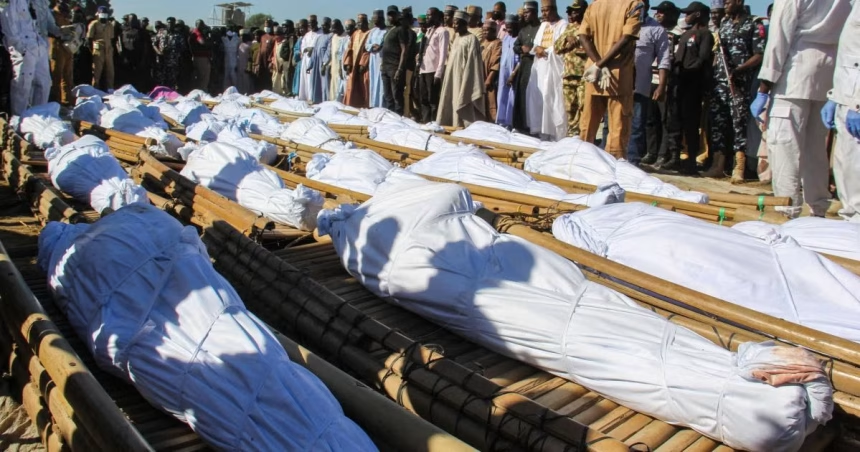
Stories of Specific Massacres: In mid-2025, the Yelwata massacre in Benue State, where reports estimate between 100 and 200 Christians were killed and thousands displaced, has become a focal point for those alleging targeted attacks based on religion.
These claims, taken together by some groups, suggest a violent pattern where civilians who are Christian are attacked, displaced, abducted, or killed in various parts of Nigeria especially in Middle Belt, North-Central, and some northern states.
What the Government Says: Denials and Responses
The Federal Government and various ministries have strongly rejected the idea that there is a Christian genocide taking place. Key points in their response:
The Minister of Information and National Orientation, Mohammed Idris, called such allegations “false, baseless, despicable and divisive.” He says framing security challenges as a religious genocide oversimplifies the complex causes of violence in Nigeria.
The government asserts that “terrorists and criminals” do not discriminate by faith, and that Muslims, Christians, and non-religious people all suffer from attacks.
The FG points to government achievements such as neutralizing over 13,500 terrorists, rescuing nearly 10,000 hostages between May 2023 and February 2025, and capturing leaders of extremist groups as proof of action.
President Bola Ahmed Tinubu also publicly dismissed genocide claims, stating that no faith community is “under siege,” and that such claims are designed to sow division.
Analysis: Does the Evidence Support “Genocide”?
Definition of Genocide: Legally, genocide refers to acts committed with intent to destroy, in whole or in part, a national, ethnic, racial, or religious group. Proof requires evidence of intent, scale, targeting, and state orchestration.
Many reports show violence by non-state actors (bandits, herdsmen, insurgents), often in regions with weak security infrastructure. Some attacks appear religiously motivated, others are tied to land disputes, governance lapses, ethnic tensions, or criminality. Religion is often one factor, but not always the sole one.
Data Reliability and Verification Issues: Numbers vary widely depending on sources; some rely on eyewitness accounts, some on media reports, some on NGO research. Verification is often difficult in remote areas.
There is overlap between violence types: banditry, herdsmen-farmer conflicts, and religiously claimed attacks. Disentangling motive whether an attack is “because someone is Christian” or simply in a farming area that happens to be Christian-majority is challenging.
Overlapping Victims: Reports show many non-Christians are also attacked. The government insists that many victims are Muslims or people of other religions.
Analysts caution against narratives that cast one religious group only as victim; such framing can increase polarization and reduce cooperation in counter-terror operations.
Why This Matters: Stakes of the Narrative
Public Trust & Policy Response: If citizens believe one group is being systematically targeted, it may reduce confidence in government and fuel vigilante or sectarian violence.
International Attention and Aid: Genocide allegations draw global scrutiny, potential sanctions, or pressure. Countries and agencies might base policy or funding decisions on perceived violations of rights.
Social Cohesion: Narratives that emphasize religious victimization can inflame mistrust between communities, even where local grievances are not religious but about land, resources, or governance.
The evidence indicates that many Christians in Nigeria are being killed, abducted, or displaced in security crises involving insurgents, herdsmen, bandits, and other violent non-state actors. However, whether these incidents amount to a “genocide” in the legal or international sense is far from established.
While some reports present alarming statistics, the government counters that these claims are exaggerated or taken out of context. What is clear is that violence is widespread, affects many communities, and that religious identity is one of several factors implicated.
Ultimately, while the “Christian genocide” label remains contested, the underlying issues are serious: mass insecurity, weak protection for civilians, and a need for robust, impartial investigations. Clarity, transparency, and credible data are essential if Nigeria is to address the root causes and ensure citizens of all faiths can live safely.