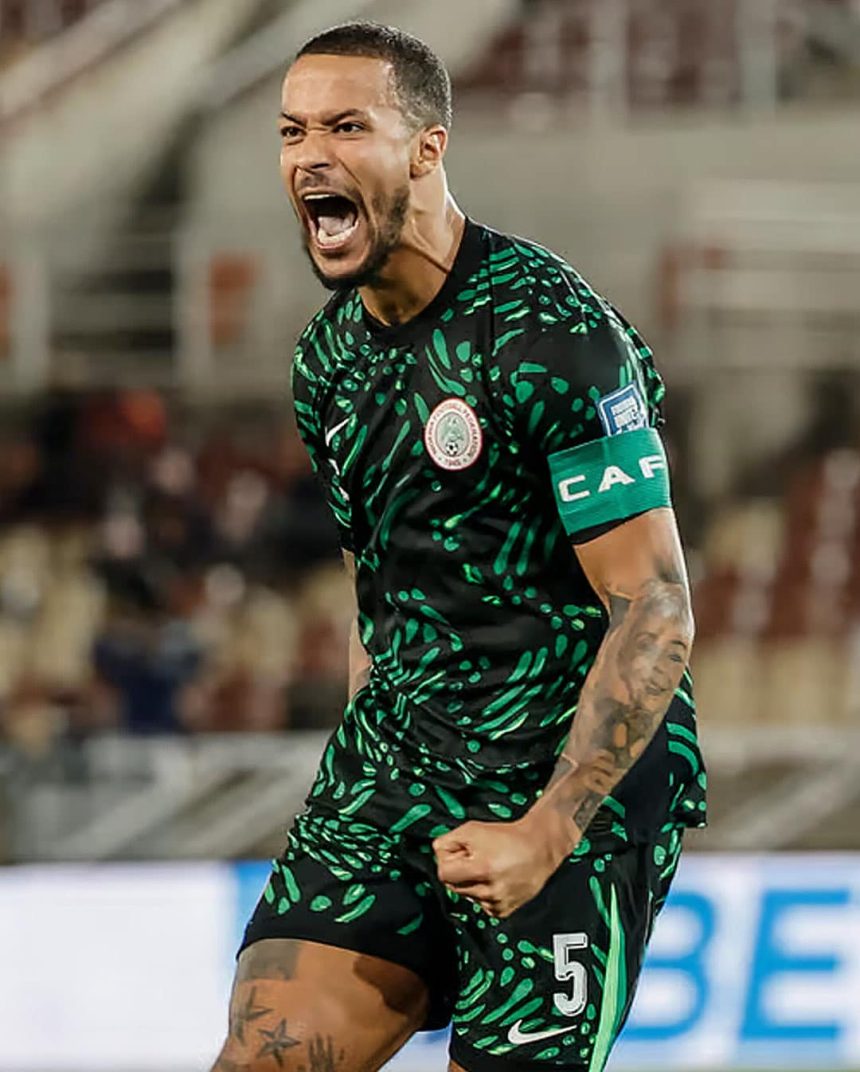
William Troost-Ekong’s retirement from the Super Eagles closes a defining chapter in Nigeria’s football story. For years, he embodied composure, responsibility, and courage not only as a centre-back, but as Nigeria’s most reliable penalty taker with a flawless conversion record. His departure leaves two urgent vacancies: a trusted finisher from the spot and a new leader to guide a team in transition.
The circumstances surrounding his final games, the criticism after the own goal, the bold penalty against Lesotho, and the controversial decision to keep him out of the shootout against DR Congo underline a truth Nigerian football knows too well: when a player challenges the system, the system often responds harshly. Ekong exposed unpaid bonuses, and soon after, his role was quietly reduced. Politics found its way onto the pitch.
Now the Super Eagles must rebuild with youth, hunger, and a fresh identity.
With Ekong gone, Nigeria turns not to its old guard, but to its rising stars, players whose talent, confidence, and modern training offer the promise of stability from the spot.
Gift Orban explosive and fearless, has the temperament for high-pressure moments. His finishing is ruthless, his technique clean, and his confidence unwavering, the kind of striker who steps up without hesitation.
Victor Osimen, powerful and unpredictable, thrives in big moments. His blend of strength, technique, and precision makes him a natural candidate for penalties. He hits the ball with authority, the kind of authority that goalkeepers fear.
Akor Adams, tall, calm, and clinical, has already shown he can convert under pressure at club level. His composure inside the box makes him a strong, underrated option.
Each of these young forwards offers something different, but they share one crucial trait: they are unafraid. Nigeria now needs pen takers who combine skill with a modern striker’s mentality bold, direct, and confident.
Beyond penalties, Nigeria must also identify the next voice of authority in the dressing room. And once again, the spotlight falls on its new generation.
Calvin Bassey, represents passion, adaptability, and resilience. Despite his penalty miss against DR Congo, he remains one of Nigeria’s most committed young players, vocal, hardworking, and increasingly experienced.
Bright Osayi-Samuel, carries the energy and aggression needed in modern football. He plays with honesty and intensity, the kind that can inspire teammates in difficult matches.
Raphael Onyedika, young but mature beyond his years, offers calm midfield leadership, the type of player who dictates tempo and leads through control rather than noise.
This new leadership won’t look like Ekong’s. It will be faster, more dynamic, and heavily influenced by European-style training and discipline.
The search for a penalty taker isn’t just about technique. The hunt for leadership isn’t just about personality. Both are reflections of a deeper issue: the Super Eagles are rebuilding a system bruised by politics, inconsistency, and a lack of transparency.
Young players give Nigeria something the older generation struggled to maintain belief. They are not burdened by old football politics. They are not tied to past failures. They are not haunted by the system Ekong often clashed with.
With proper support, they could usher in a new era for the national team.
Ekong’s retirement marks the end of one era and the beginning of another. Nigeria now stands at a crossroads: repeat old mistakes or embrace a new crop of fearless footballers ready to write a new chapter.
The next penalty taker will likely be a young, hungry forward.
The next leader will emerge from the next generation, not the last.
And the future of the Super Eagles may depend on these rising stars stepping into roles Nigerian football desperately needs filled.
The team is evolving, not backwards, but forwards. And this time, youth will lead the way.