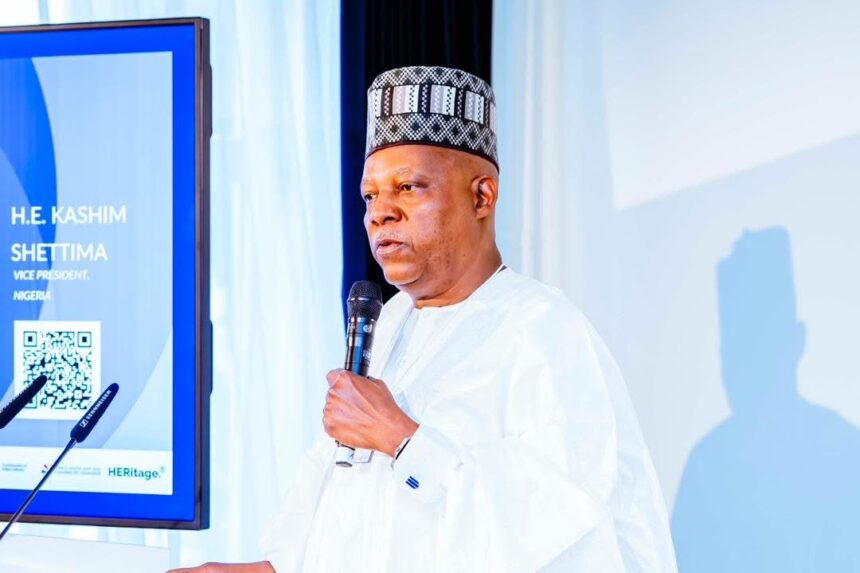
Vice President Kashim Shettima has called on African nations to adopt homegrown solutions to address the continent’s economic challenges, urging a shift from import dependence to local production and from aid reliance to investment-driven growth.
Shettima made the call on Thursday at the High-Level Accra Reset Initiative meeting held on the sidelines of the 2026 World Economic Forum (WEF) in Davos.
According to the Vice President, Africa’s long-term prosperity can only be achieved by strengthening domestic productive capacity and transforming natural and human resources into sustainable wealth.
“Africa cannot rise on applause alone. We rise when we build,” Shettima said, stressing that prosperity must be locally generated rather than externally supplied.
Highlighting Nigeria’s industrial progress, Shettima said the Dangote Refinery has positioned the country to become a net exporter of refined petroleum products, marking a major shift from decades of fuel import dependence.
Read Also: VP Shettima Departs Abuja to Guinea for Inauguration
He described the development as evidence of what is possible when African capital aligns with industrial ambition, adding that countries move from “price takers to value makers” when production is supported by infrastructure and clear policy frameworks.
The Vice President also emphasized the role of technology in accelerating Africa’s industrialization, citing the potential of modular factories, artificial intelligence and robotics to boost manufacturing capacity across the continent.
On human capital development, Shettima noted that Africa’s prosperity depends on labour mobility and skills transfer, revealing that Africans in the diaspora remitted about $95 billion in 2024, representing over five percent of the continent’s GDP.
He called for freer movement of skills across Africa, describing mobility as a competitive advantage in the global economy.
Shettima further outlined Nigeria’s healthcare industrialization strategy, referencing the Presidential Initiative for Unlocking the Healthcare Value Chain (PUHVAC), launched in October 2023, which aims to strengthen local pharmaceutical production and improve health security.
He described the Accra Reset Initiative as a platform for redefining Africa’s development path, urging leaders to move “from dependency to dignity, from aid to investment, and from rhetoric to results.”
Earlier, Ghana’s President John Mahama criticized Africa’s current engagement model with developed economies, describing it as transactional and insufficient for meaningful transformation.
He said the Accra Reset Initiative was designed to provide practical solutions to Africa’s economic challenges and ensure the continent plays an active role in shaping the emerging global order.
Former Nigerian President Olusegun Obasanjo warned that countries that fail to organize strategically risk becoming marginal players in global economic restructuring, while former Vice President Yemi Osinbajo said the forum was aimed at helping African governments rethink economic transformation strategies.