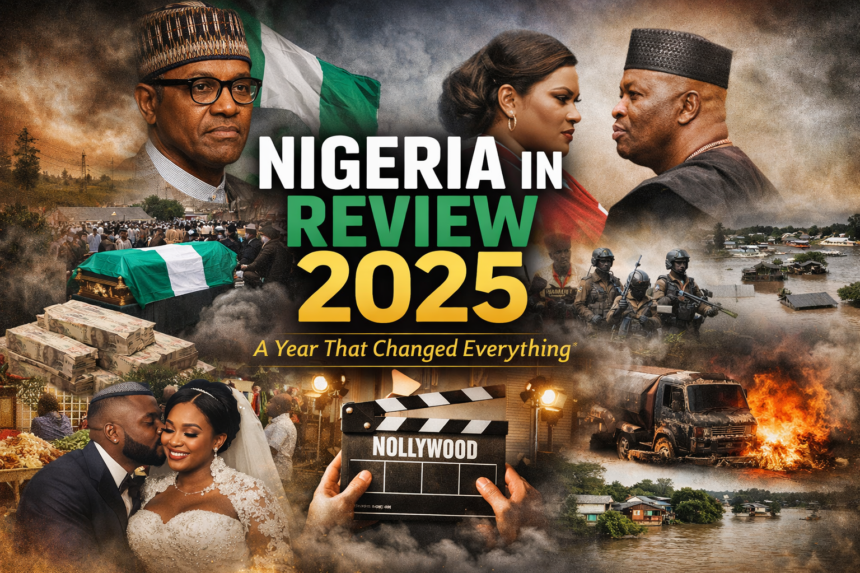
The year was heavy with consequence: decisions made at the highest levels of power, economic pressures felt in every household, grief that united the nation, and cultural moments that reminded Nigerians of their resilience. As 2026 begins, the echoes of 2025 are still loud, in policy rooms, on the streets, and across social timelines.
This is not just a recap. It is a reckoning with the moments that mattered most.
Mourning a Former Leader, Debating His Legacy
The most defining national event of 2025 was the death of former President Muhammadu Buhari, a figure whose influence spanned nearly four decades of Nigerian political history. Buhari, who ruled as both a military head of state and a democratically elected president, died in July at the age of 82. His passing triggered days of national mourning and a state burial in Daura, Katsina State.
Beyond the ceremonies, Buhari’s death reopened long-standing debates about his legacy, discipline and anti-corruption on one hand, economic hardship and security challenges on the other. For many Nigerians, it marked the symbolic end of an era and forced a broader reflection on leadership, governance, and continuity.
High Inflation, New Taxes and the Pressure on Nigerians
Running parallel to national grief was a deepening economic strain that defined everyday life in 2025. Inflation remained stubbornly high for most of the year, driven by food prices, fuel costs, and currency pressures. While official figures showed signs of easing toward year-end, the lived reality for millions of Nigerians told a harsher story.
Against this backdrop, the federal government pushed through sweeping tax reforms, arguing that Nigeria could no longer sustain its fiscal deficits. The proposed laws sparked intense backlash from labour groups, small business owners, and economic analysts who warned that the timing was wrong. Despite the resistance, the reforms were signed into law and took effect on January 1, 2026, ensuring that economic policy remains one of the most contentious issues shaping the new year.
A Year of Political Crossovers and Quiet Power Consolidation
Politics in 2025 was defined less by elections and more by realignment and power struggles.
A steady stream of high-profile defections from opposition parties into the ruling APC redrew the political map, fuelling accusations of power consolidation ahead of the 2027 elections. Former governors, lawmakers, and political heavyweights crossed party lines, weakening opposition structures and intensifying debate about the health of Nigeria’s democracy.
Within the National Assembly, the rift between Senator Natasha Akpoti-Uduaghan and Senate President Godswill Akpabio became one of the most explosive political stories of the year. Allegations, counter-allegations, court cases, and a Senate suspension played out in public view, raising uncomfortable questions about gender, power, and accountability in Nigerian politics. By early 2026, Akpabio’s withdrawal of related lawsuits signalled a tentative de-escalation, but the episode left lasting scars on public trust in the legislature.
Insecurity, Insurgency and the Human Cost of 2025
While politics dominated headlines, security challenges continued to claim lives quietly and violently.
The year opened with tragedy when a fuel tanker exploded near Suleja as residents attempted to scoop petrol, killing scores of people. Later in the year, insurgent violence persisted in the North East, with mosque attacks, military operations, and renewed fears over the spread of extremist groups from the Sahel.
In December, U.S.-backed airstrikes targeting Islamic State-linked camps in north-western Nigeria marked a significant escalation in international involvement. Though framed as a tactical success, the strikes reignited debate about sovereignty, civilian safety, and the long-term strategy against terrorism.
Climate also played its part. Flooding displaced thousands across multiple states, destroying homes, farmlands, and livelihoods, a reminder that environmental threats are no longer future concerns, but present realities.
Love, Film and Celebrity Culture in a Year of Pressure
Amid the tension, Nigerians found moments of relief and joy in culture and popular life.
Celebrity weddings dominated social media and lifestyle pages, offering escapism and spectacle. The weddings of Davido and Chioma, Mr Eazi and Temi Otedola, and several other high-profile figures became cultural events, shaping fashion trends, conversations about wealth, and the evolving face of Nigerian celebrity culture.
Nollywood, too, had a defining year. Filmmakers delivered commercially successful and socially resonant stories, with films that explored love, ambition, crime, and survival in modern Nigeria. These productions reinforced Nollywood’s growing global relevance and its role as a mirror to Nigerian society, telling stories audiences recognised as their own.
Public figures such as Toke Makinwa also drew attention for personal milestones, including celebrations around family and motherhood, moments that resonated deeply in a country where community and shared joy remain powerful cultural anchors.
By the time Nigerians crossed into 2026, it was clear that 2025 had left no area untouched, not governance, not wallets, not culture, not collective memory.
The new year inherits unresolved economic questions, an increasingly fluid political landscape, ongoing security concerns, and a creative industry that continues to punch above its weight. Whether 2026 becomes a year of consolidation or further disruption will depend on how Nigeria responds to the lessons and warnings of the year just passed.
One thing is certain: 2025 was not a pause in Nigeria’s story.
It was a turning point.