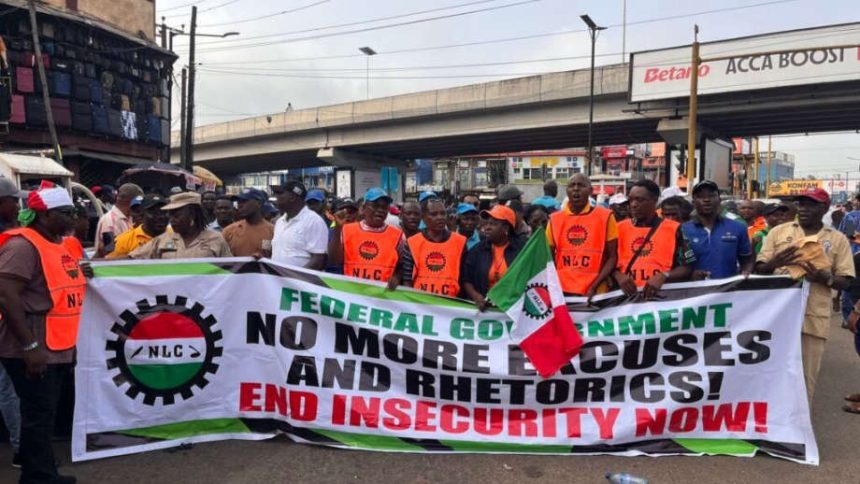
The Nigeria Labour Congress (NLC) on Wednesday carried out a nationwide day of protest described by organisers as a “National Day of Protest and Mourning” calling on the federal government to take urgent action on spiralling insecurity and the economic hardship affecting workers and ordinary Nigerians.
The demonstrations, led by NLC President Joe Ajaero, went ahead in multiple state capitals despite a late-night meeting between the President and labour leaders aimed at defusing tensions. The labour centre insisted its demands remain focused on concrete security responses and accountability for those allegedly fuelling violent crime.
Marchers and union leaders presented a short list of demands that included:
- Immediate, decisive action to curb kidnappings, killings and banditry;
- Arrest and prosecution of individuals and networks suspected of financing insecurity;
- Protection for workers and communities; and
- A pledge by the government to provide a clear plan and timeline for restoring public safety.
Speakers at rallies argued that insecurity has become a workplace and national emergency disrupting livelihoods and undermining investment and warned that failure to act could prompt more disruptive labour action.
In Abuja, the protest proceeded amid a visible security presence, with police and other security agencies deployed to key routes and public squares. Video and photo coverage showed organised marches led by labour leaders and civil society figures, including high-profile activists who joined parts of the demonstrations. Despite the mobilisation, some outlets and on-the-ground reporters described turnout in the capital as lower than expected.
Across other cities Lagos, Port Harcourt, Enugu and Kano labour rallies registered mixed participation, with local unions, students and civil society groups joining calls for stronger security measures and economic relief.
Late on Tuesday, President Bola Tinubu met with NLC officials at the State House in Abuja in what organisers described as a consultation aimed at averting full-scale disruption. After the meeting, NLC leaders said they would brief their organs before taking a final decision on whether further action, including an indefinite strike, would follow. Despite the talks, the NLC pressed ahead with the planned protest. 
Government spokespersons said the meeting was constructive and that officials had promised to respond urgently to labour’s demands; labour leaders said they would monitor follow-through closely.
Ahead of and during the marches, the NLC raised alarms about reports of plots to disrupt the protests and threatened to call an indefinite strike if protesters were attacked. The union called for guarantees of safety for demonstrators and demanded that security agencies protect citizens exercising their right to peaceful assembly. Authorities maintained their deployment was intended to protect both protesters and public order.
Public reaction to the protests was mixed: some citizens applauded the unions for spotlighting insecurity and its human cost, while others faulted labour for risking disruption amid fragile economic conditions. Analysts say the government-labour dialogue will be decisive: if authorities present a credible security plan and implement quick wins, the NLC may pause escalation; otherwise, the union has warned it could escalate to an indefinite strike.
The NLC’s protest highlights a convergence of security and economic grievances that are eroding public confidence. Labour’s capacity to mobilise nationwide even if turnout varies by city gives it leverage. For the government, credible action to restore safety and protect livelihoods will be essential to avoid prolonged industrial action that could further damage the economy.