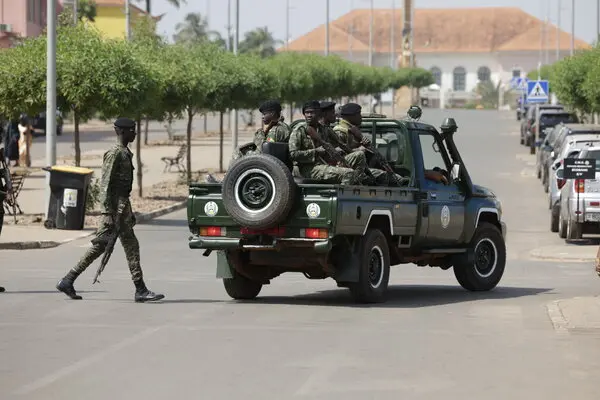
Guinea-Bissau’s ruling military junta has reopened all land, air, and sea borders and eased the nationwide curfew, a day after soldiers seized power, suspended the electoral process, and dissolved key democratic institutions in a dramatic escalation of the country’s political crisis.
The announcement came on 27 November 2025, following 24 hours of heightened tension, restricted movement, and uncertainty across the West African nation.
General Lansana Mansali, the Inspector General of the Armed Forces, said the border reopening was necessary to “allow normal life, commerce and mobility to resume,” even as the junta continues to justify its takeover on national-security grounds.
On 26 November, hours before the release of election results, heavy gunfire erupted near the presidential palace. Shortly after, a group calling itself the High Military Command for the Restoration of National Security and Public Order appeared on national television to announce that:
- It had taken full control of the state
- The electoral process was suspended
- All borders were closed until further notice
- A 7 p.m. nationwide curfew was imposed
- Public institutions and media operations were temporarily halted
The junta accused unnamed political actors of attempting to “destabilize the country,” referencing alleged plots and security threats.
The move marks Guinea-Bissau’s fifth coup since independence in 1973, deepening its reputation as one of Africa’s most politically fragile nations.
According to military spokespersons, the decision to reopen the borders was driven by economic pressure, the need to avoid escalating humanitarian challenges, and increasing international scrutiny.
What Has Now Reopened:
- Airports in Bissau and regional hubs
- Land borders with Senegal and Guinea
- Ports and maritime checkpoints
- Inter-regional commercial activities
- Internal movement, though the curfew remains partially in effect
Flight operations that were halted have now resumed, and businesses near the Dakar-Bissau corridor reported a surge in cross-border traffic shortly after the announcement.
The global community has reacted cautiously but firmly:
ECOWAS: The West African bloc has condemned the takeover, describing it as a “serious setback to democratic governance.” Emergency consultations are underway regarding possible sanctions or mediation.
United Nations: The UN is “closely monitoring the situation,” urging restraint and the immediate restoration of constitutional order.
African Union (AU):The AU Peace and Security Council is considering suspension of Guinea-Bissau pending a formal report.
Portugal (former colonial power):Portugal called for an end to violence, urging all parties to return to dialogue and ensure citizen safety, especially as vote counting had already resumed before the coup.
Relief Among Citizens and Traders.Many residents welcomed the reopening, especially traders whose livelihoods rely on cross-border movement.
Fear and Uncertainty Remain.Despite eased restrictions, residents fear prolonged military rule. Some civil society groups reported they were “intimidated” from making public statements.
Social Media Buzz.Videos of reopened checkpoints circulated widely on X (formerly Twitter), while activists demanded transparency on the junta’s next steps.
What’s Next for Guinea-Bissau?
The junta has not provided a timeline for:
- Restoring elections
- Reopening parliament
- Reinstating civil institutions
- Establishing a transition plan
Analysts warn that while the easing of curfew and border reopening provide temporary relief, they do not signal a return to democratic order.
Regional & Economic Implications: Trade routes through West Africa may stabilize temporarily,Investors may hesitate until international bodies recognize a transition roadmap and Humanitarian agencies are monitoring potential displacement or shortages caused by the initial lockdown
Guinea-Bissau’s decision to reopen its borders and ease curfew signals an attempt to reduce public tension and economic disruption. However, with democratic structures suspended and military authorities firmly in control, the country sits at a critical crossroads. The coming weeks will determine whether this easing represents a step toward stability or the beginning of a prolonged military-led transition.