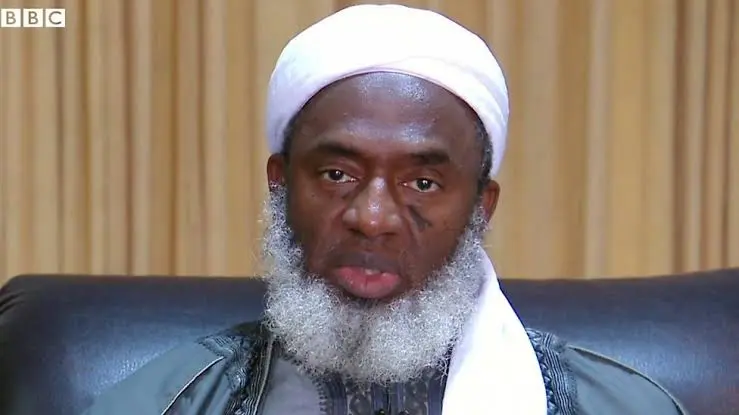
Islamic cleric Sheikh Ahmad Gumi has stirred national discussion by declaring that he would personally lead a campaign for the release of Nnamdi Kanu, the convicted leader of the Indigenous Peoples of Biafra (IPOB), if Kanu publicly shows remorse and calls for peace. Speaking on Channels Television’s The Morning Brief, Gumi framed his proposal as a pragmatic alternative to relying solely on military force to resolve conflicts in Nigeria.
Non-Kinetic Solutions Over Force
Gumi argued that military action alone is insufficient for resolving conflicts with armed groups. Citing historical and global examples, he noted that conventional armies often struggle against guerrilla tactics, emphasizing that violence without dialogue rarely produces lasting results. He urged the government to consider non-kinetic approaches, including negotiation and reconciliation, to address the root causes of unrest rather than relying purely on force.
He stressed that his advocacy is not an endorsement of criminality, but a call for strategic engagement: “Dialogue with groups willing to lay down arms is preferable to defaulting to violence.”
Historical Precedents and Conditional Amnesty
Gumi highlighted past Nigerian examples of conditional clemency as a tool for peacebuilding. He referenced:
- Former President Shehu Shagari’s pardon of Odumegwu Ojukwu, which allowed post-civil war reconciliation;
- Former President Umaru Musa Yar’Adua’s amnesty for Niger Delta militants, which reduced violent attacks in oil-producing regions.
By invoking these examples, Gumi suggested that a conditional approach for Kanu, requiring public remorse and a commitment to peace, could help de-escalate tensions in southeastern Nigeria. He positioned himself as ready to advocate for Kanu, but only if the IPOB leader demonstrates willingness to renounce violence and embrace dialogue.
Sheikh Gumi’s remarks reinforce his longstanding view that engagement and conditional amnesty can be more effective than force alone. His conditional support for Nnamdi Kanu’s release underscores a key debate in Nigeria: whether the state can balance justice with reconciliation to achieve lasting peace.