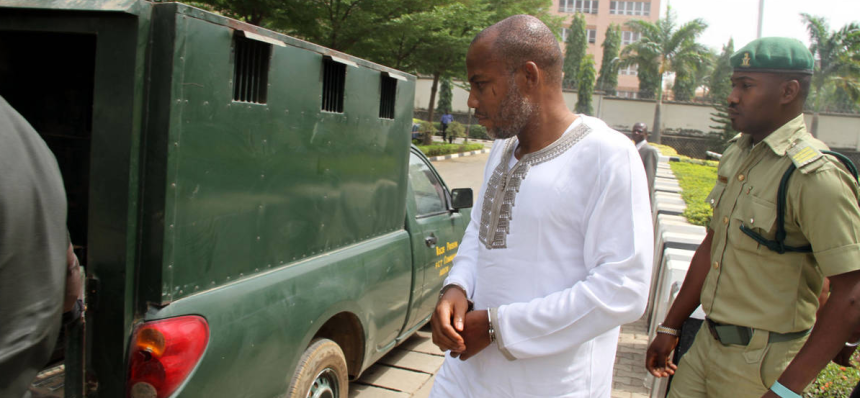
The Department of State Services (DSS) has transferred the convicted leader of the proscribed Indigenous People of Biafra (IPOB), Nnamdi Kanu, to the Nigerian Custodial Centre in Sokoto. The move comes less than 24 hours after a Federal High Court in Abuja sentenced him to life imprisonment on terrorism charges.
Justice James Omotosho, who delivered the ruling on Thursday, ordered the secret police to relocate Kanu to any correctional facility in the country except the Kuje Custodial Centre in Abuja. The court held that Kanu used acts of terrorism in pursuit of his separatist agitation, which sought the secession of the South-East, South-South, and parts of Benue and Kogi from the Nigerian federation.
A senior DSS source confirmed that the agency complied with the directive immediately after the sentencing, resulting in Kanu’s movement to the Sokoto facility.
Kanu’s former lawyer and long-time legal consultant, Aloy Ejimakor, also confirmed the transfer in a statement posted to his X handle on Friday, he criticized the decision, arguing that relocating Kanu to Sokoto had placed him far from his family, legal defence, and support base.
Ejimakor drew a historical comparison to the 1963 conviction of Chief Obafemi Awolowo, stating that the late statesman was sent to a “neutral zone” in the East rather than a region aligned with his political rivals.
Kanu’s legal troubles date back to 2015 when he was first arrested on charges including treasonable felony and terrorism arising from his leadership of IPOB, which was proscribed by the Nigerian government in 2017. After jumping bail in 2017, Kanu resurfaced abroad but was re-arrested and extradited from Kenya in 2021 under circumstances that remain a subject of controversy.
His conviction on seven counts of terrorism marks a new phase in the long-running case, which has significantly influenced political tensions and security issues in the South-East.