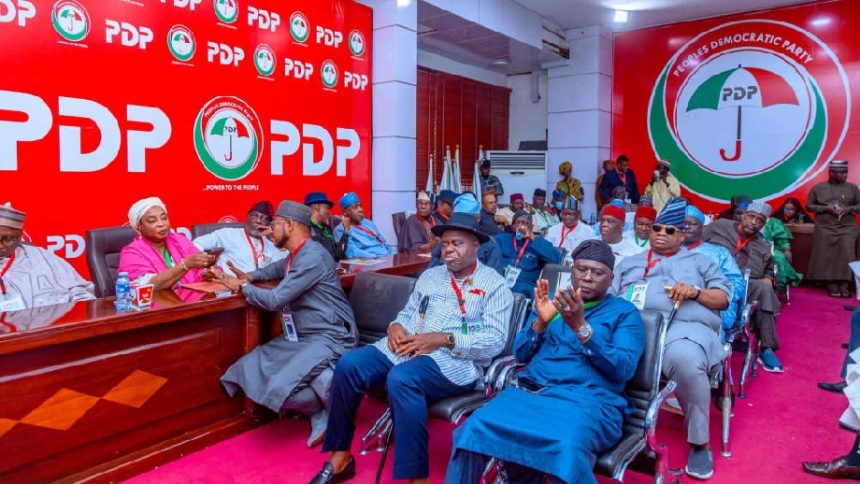
The Peoples Democratic Party (PDP) is facing one of the most turbulent moments in its history after its national convention in Ibadan on November 15–16 descended into a full-scale political and legal crisis. What was intended to unify the opposition party ahead of the 2027 elections instead deepened internal fractures, triggered high-profile expulsions, and produced rival party structures now laying claim to legitimacy.
Mounting Tensions Before the Convention
In the weeks leading up to the convention, tensions were already high. The Board of Trustees (BoT), led by Senator Adolphus Wabara, set up a reconciliation committee chaired by Ambassador Hassan Adamu to mediate between the warring factions. The committee eventually recommended suspending the convention and establishing an all-inclusive caretaker committee, warning that proceeding under current conditions could destabilize the party further.
Compounding the crisis, the PDP was hit by conflicting court orders. A Federal High Court in Abuja issued a final injunction restraining the party from holding the convention, while an Oyo State High Court ruled that it could proceed. The faction aligned with Nyesom Wike rejected the Oyo ruling, insisting a state court could not override a federal judgment, especially on a matter involving INEC.
Meanwhile, the Damagum-led National Working Committee (NWC) suspended Samuel Anyanwu, Kamaldeen Ajibade, Umaru Bature, and Okechukwu Osuoha over alleged anti-party activities. Former Senate President Bukola Saraki joined those calling for the convention to be postponed, arguing that the party risked deepening internal damage.
Factional BoT Emerges
As the crisis escalated, the Wike-aligned faction announced the dissolution of the Wabara-led BoT and inaugurated Senator Mao Ohuabunwa as chairman of a rival BoT. The faction insisted that the party must comply with the Federal High Court’s order halting the convention and condemned the leadership for “illegally” pressing ahead.
Convention Goes Ahead Despite Warnings
Despite the rising legal and political risks, the Damagum-led NWC proceeded with the Ibadan convention. In one of the most dramatic developments, delegates passed a motion expelling several high-profile politicians, including FCT Minister Nyesom Wike, former National Secretary Samuel Anyanwu, and former Ekiti Governor Ayo Fayose over alleged anti-party activities. The motion was moved by party elder Bode George and seconded by Bauchi State PDP Chairman Samaila Buga. The convention also dissolved the Damagum-led NWC, replacing it with a newly elected leadership slate, further deepening the party’s internal rifts.
Aftermath and Escalating Fallout
The expulsions triggered swift reactions across the party. The Wike/Anyanwu faction announced emergency BoT and NEC meetings to determine its next steps, signaling intentions to challenge the legitimacy of the convention. The Wabara-led BoT, insisting it remains the authentic BoT of the party, warned that the decision to proceed with the convention, despite a federal court order and reconciliation efforts, could push the PDP toward a permanent split.
The rival BoT aligned with Wike insists the convention’s outcomes are invalid and unenforceable, arguing that any decisions made under a court-restrained process cannot stand.
Analysts Warn of Parallel Structures and a Possible Split
Political analysts say the PDP is now effectively operating with parallel leadership structures, rival BoTs, and conflicting claims to authority. With prominent figures expelled, court battles looming, and factions refusing to back down, the party faces what could be its most severe internal crisis in years.
The outcome of this power struggle remains uncertain, and observers will be watching closely to see how the PDP navigates its divided leadership and legal challenges in the months ahead.