President Bola Ahmed Tinubu on Thursday reaffirmed his administration’s commitment to building an inclusive, secure, and industrialised Nigeria, stressing that national productivity and unity remain collective responsibilities.
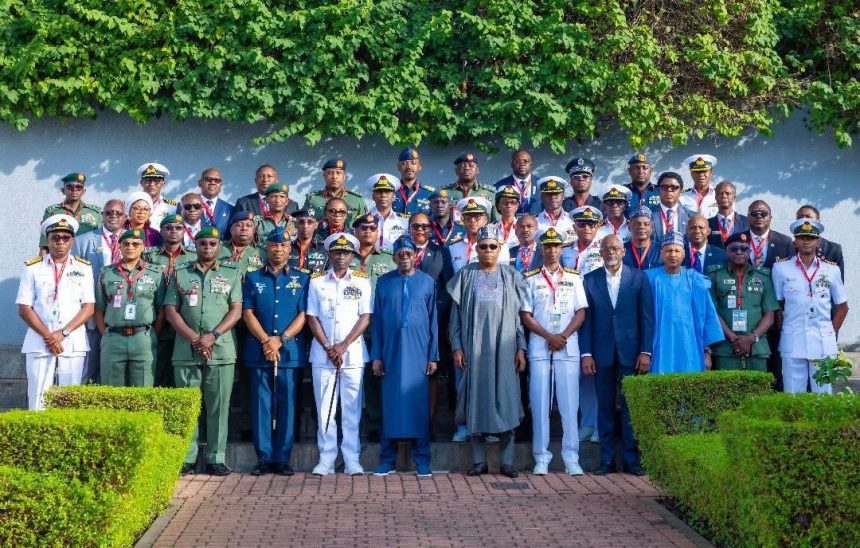
Speaking while receiving participants of Course 33 of the National Defence College at the State House, Abuja, President Tinubu said his government would continue to empower the nation’s defence and military institutions to produce highly trained officers capable of strengthening national power and security.
“We must develop Nigeria. The strategic path to industrialisation, as enumerated in your presentation, gives credence to that,” the President said, adding that inclusive governance and sustainable development are critical to securing the nation’s future.
Read Also: Tinubu Urges Editors to Uphold Truth, Verification, and National Cohesion
Responding to the team’s research presentation titled “Harnessing Indigenous Manufacturing for Enhanced National Security by Year 2040,” President Tinubu assured that his administration would review their recommendations for possible implementation.
He emphasised the need for intellectual curiosity and innovative thinking to tackle emerging national challenges.
“It is our joint responsibility to ensure that this nation is productive, governed inclusively, and safeguards the future of our unborn generations,” he said.
The President urged Nigerians to remain resilient and focused on developing the economy through industrialisation and human capacity development.
Commandant of the National Defence College, Rear Admiral A. Ahmed, said Course 33 focused on “Strengthening Institutions for National Security and Development in Nigeria.”
He disclosed that the current course comprised 99 participants, including military officers, police personnel, civil servants, and 23 international representatives from Africa, Asia, and South America.
Ahmed noted that the College has produced over 3,000 graduates since its establishment in 1992.
The team leader, Captain M.A. Ahmed, said the group’s study, which covered 23 countries across three continents, examined how indigenous manufacturing contributes to economic resilience and national security.
He said lessons from Qatar’s economic diversification inspired their recommendation for a long-term “Project Native 2040” to strengthen Nigeria’s industrial base.