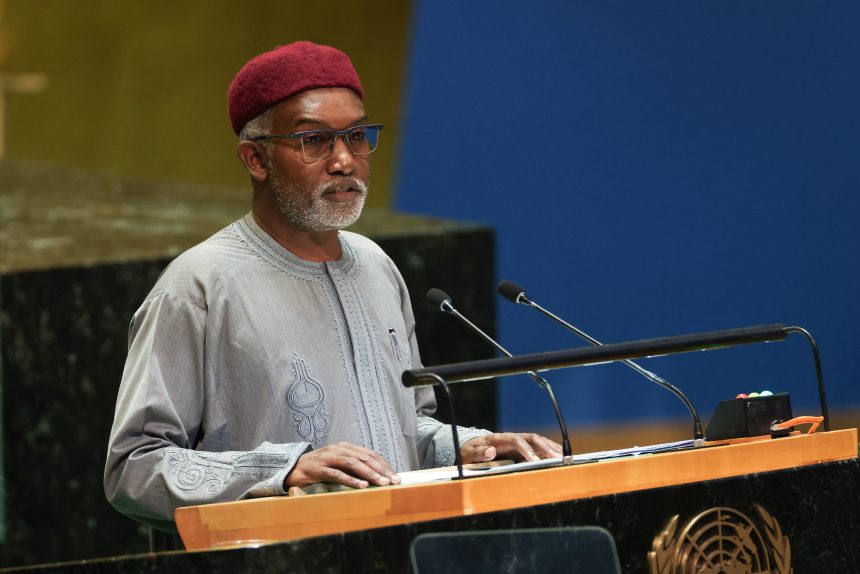
Nigeria’s Minister of Foreign Affairs, Yusuf Tuggar, has cautioned former U.S. President Donald Trump against portraying Nigeria as a country complicit in religious persecution, warning that such rhetoric could destabilize Africa’s most populous nation.
Tuggar Rejects Allegations of Religious Persecution
Speaking during a press conference in Berlin alongside German Foreign Minister Johann Wadephul, Tuggar firmly rejected claims that the Nigerian government supports or condones violence against Christians or any other religious group. He said the international community must avoid framing Nigeria’s security challenges in religious terms, warning that doing so could risk “creating another Sudan.”
Tuggar held up a copy of the Nigerian Constitution as he spoke, emphasizing that it guarantees freedom of religion and explicitly prohibits discrimination based on faith.
“This is what guides us, and this is what shows it’s impossible for there to be a religious persecution that can be supported in any way, shape, or form by the government of Nigeria,” he said. He stressed that no arm of government, federal, state, or local endorses religious bias of any kind.
Response to Trump’s Threats and U.S. Pressure
Tuggar’s comments came in response to remarks made by Donald Trump, who recently alleged on social media that “thousands of Christians are being killed in Nigeria in very large numbers.” Trump also threatened to suspend U.S. aid and consider military intervention if the situation did not improve.
The U.S. State Department later listed Nigeria among “Countries of Particular Concern” for alleged violations of religious freedom.
Tuggar did not respond directly to the suggestion of military action but warned that such rhetoric could inflame tensions within Nigeria’s diverse religious communities. Drawing parallels with Sudan, he said:
“We’ve seen what has happened in Sudan with agitations for partition based on religion and tribal sentiments. We don’t want a repeat of that tragedy in Nigeria.”
Nigeria’s Diversity and Unity
The foreign minister reaffirmed Nigeria’s commitment to democracy, peace, and religious freedom. He described Nigeria as a diverse but united nation of over 230 million people, roughly split between Muslims and Christians, saying that diversity remains one of the country’s greatest strengths.
“Nigeria’s diversity has always been a source of cultural and social richness, not division,” Tuggar said. He added that the government continues to promote harmony among its many ethnic and religious groups.
Complex Roots of Nigeria’s Violence
Security experts and regional analysts note that while violent attacks have occurred in parts of northern and central Nigeria, they are driven by a combination of factors, including insurgency, land disputes, banditry, and resource competition, rather than state-sponsored religious persecution.
Observers caution that framing these conflicts as religious persecution oversimplifies a complex reality and risks deepening social divisions.
Diplomatic Context and International Reactions
Tuggar’s remarks underline Nigeria’s broader diplomatic position: defending national sovereignty while resisting what it perceives as external interference or misrepresentation. His reference to Sudan underscores concerns that international narratives about religion could inadvertently fuel instability.
Nigeria’s allies, including Germany, China, and the African Union, have recently expressed support for its efforts to preserve national unity and promote religious tolerance amid ongoing security challenges in the Sahel region.
Enduring Commitment to Religious Freedom
Concluding his remarks, Tuggar reiterated that Nigeria’s constitution remains the strongest safeguard against discrimination and persecution. “The Nigerian government stands for equality of all faiths,” he said, “and no external actor should try to divide our people along religious lines.”