
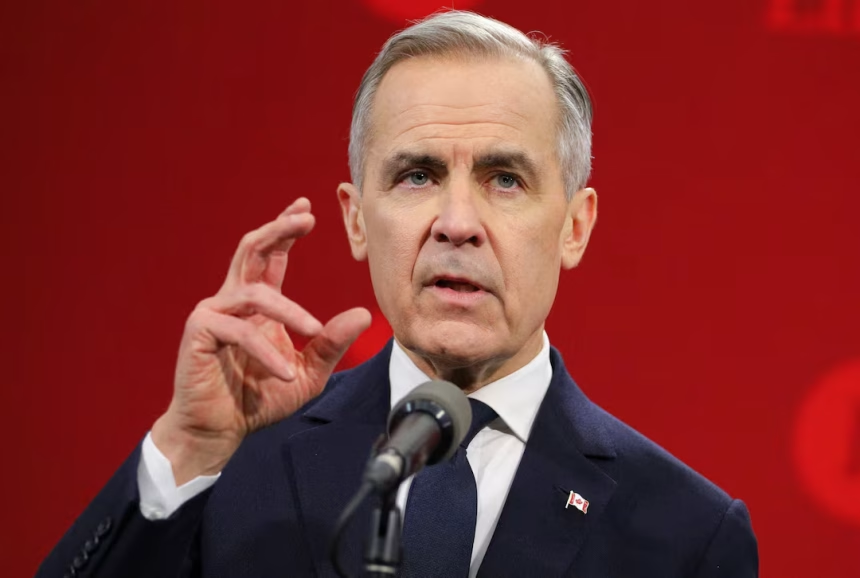
In a major policy shift that has stirred debate across the automotive and trade sectors, the Canadian government has announced that it will slash tariff-free car imports from global auto giants Stellantis and General Motors (GM). The move, part of an effort to rebalance domestic manufacturing priorities, marks one of the most significant trade revisions in Canada’s automotive history.
Deputy Prime Minister and Finance Minister Chrystia Freeland confirmed the decision during a press briefing in Ottawa on Thursday, describing it as a “necessary recalibration” aimed at boosting local production and ensuring fair competition within the North American market.
“Canada has long supported a strong, fair, and sustainable automotive sector,” Freeland said. “Our tariff adjustments are designed to protect Canadian workers and promote domestic innovation, particularly in electric vehicle manufacturing.”
The announcement effectively reduces the volume of vehicles that Stellantis and GM can import into Canada under existing tariff-free arrangements established by the USMCA (United States-Mexico-Canada Agreement). Analysts say the policy shift could reshape automotive supply chains and redefine corporate investment strategies across North America.
Under previous trade frameworks, both Stellantis the multinational parent company of brands like Jeep, Dodge, and Chrysler and GM benefited from broad exemptions that allowed thousands of vehicles to enter Canada annually without import duties. That arrangement will now be scaled back significantly, according to the government’s new directive.
Industry observers say the change underscores Ottawa’s growing focus on domestic manufacturing, clean energy transitions, and the future of electric vehicles (EVs).
The Canadian government’s latest move aligns with its industrial policy to build up local EV and battery production capacity. The country has committed billions of dollars to support manufacturing plants in Ontario and Quebec, including multi-billion-dollar investments by both Stellantis and Volkswagen in EV battery facilities.
By scaling back tariff-free imports, Ottawa hopes to pressure global automakers to strengthen their local assembly lines rather than relying on cheaper imports.
“Canada wants to ensure that companies that benefit from government incentives also contribute meaningfully to local job creation and technological growth,” said Dr. Elise Morgan, an automotive trade analyst at the University of Toronto. “This policy sends a clear signal if you want market access, you must invest in Canada.”
Both automakers expressed concern over the sudden policy change, warning that it could disrupt supply chains and affect dealership pricing in the short term.
In a statement, Stellantis said, “We remain committed to our partnership with Canada and will continue to evaluate the government’s new trade measures. However, we believe collaboration and stability are key to long-term industry growth.”
GM echoed similar sentiments, emphasizing that “trade predictability” remains vital for consumer confidence and manufacturing efficiency. The company noted that it continues to work closely with Ottawa to “align on shared goals for sustainable mobility and economic growth.”
The policy has drawn mixed reactions from economists, auto workers, and political commentators. Proponents argue that the decision will strengthen Canada’s industrial base and create incentives for long-term investment in local production.
The Canadian Auto Workers Union hailed the move as a “victory for working Canadians.” Union president Lana DiMarco stated, “For too long, multinational corporations have reaped the benefits of our markets without giving enough back. This policy ensures that our workers’ contributions are recognized and rewarded.”
However, critics warn that the policy could drive up vehicle prices for consumers and create tension with trade partners, particularly the United States, whose automotive exports to Canada form a major part of the cross-border economy.
“The reality is that Canada’s car market is deeply integrated with U.S. manufacturing,” said David Kaplan, a senior fellow at the North American Trade Council. “Any disruption could impact everything from parts supply to dealership inventories within months.”
The new restrictions come amid a delicate balance in North American trade relations. U.S. trade officials have yet to issue an official response, but early indications suggest Washington may view the move as protectionist.
A senior White House trade advisor, speaking anonymously to Reuters, said, “Canada’s decision raises concerns about adherence to the spirit of the USMCA. We’ll be reviewing its implications closely.”
Mexico, another key USMCA partner, may also be watching the development with interest, as similar policies could potentially affect its own automotive export ambitions.
The policy shift fits into Prime Minister Justin Trudeau’s broader agenda to make Canada a hub for clean energy and sustainable technology. With the global automotive sector rapidly pivoting toward EVs and carbon neutrality, Ottawa is positioning itself as a critical player in that transformation.
“The world’s automotive future is electric, and Canada intends to be at the center of it,” Freeland said during the announcement. “This decision is about ensuring our workers and industries lead, not follow.”
The government has indicated that it will continue to engage with major automakers in negotiations over the coming months to “ensure a smooth transition” while upholding trade commitments under the USMCA.
While the long-term effects remain uncertain, one thing is clear Canada’s decision to cut tariff-free car imports represents a turning point for its automotive industry. It signals a more assertive stance on trade sovereignty, a growing emphasis on domestic production, and a readiness to challenge global players to invest more meaningfully within its borders.
As the dust settles, industry leaders, consumers, and policymakers alike will be watching closely to see whether this bold move drives sustainable growth or sparks new trade tensions across North America.