
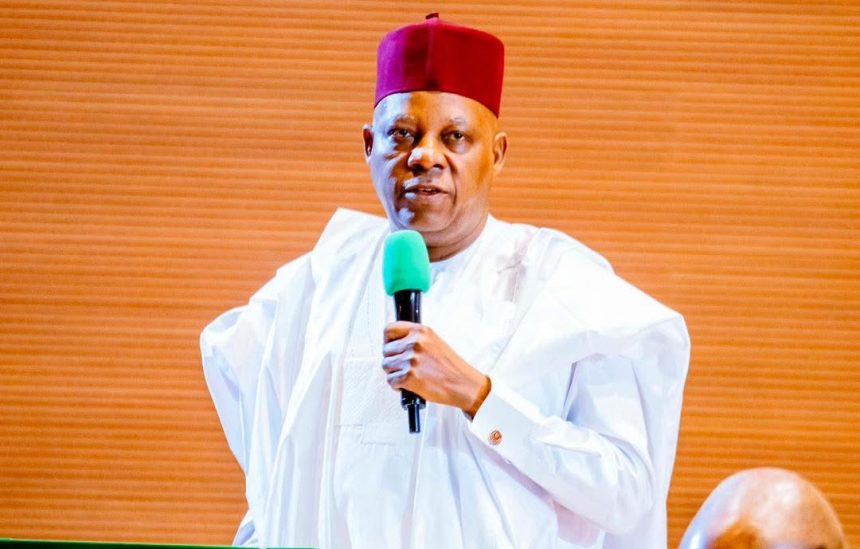
President Bola Ahmed Tinubu has urged the Nigerian judiciary to remain impartial and uncompromising in the administration of justice, warning that a compromised judiciary poses a threat to the nation’s moral foundation.
Declaring open the Economic and Financial Crimes Commission (EFCC) and National Judicial Institute (NJI) Workshop for Justices and Judges in Abuja on Monday, President Tinubu, represented by Vice President Kashim Shettima, said his administration remains committed to improving the welfare and independence of judicial officers.
He noted that recent reviews of judicial remuneration were part of a broader effort to strengthen judicial autonomy, adding that the government has refrained from interfering in judicial and anti-corruption matters.
Read Also: FG Inaugurates Steering Committee for €40m EU-Supported Education
“There is no person or group who can accuse this administration of shielding political actors on account of their affiliation to this government or the political party,” Tinubu said. “We have allowed both the judiciary and the anti-graft agencies to exercise their constitutional and statutory powers.”
Highlighting progress in the fight against corruption, the President disclosed that the EFCC secured over 7,000 convictions and recovered more than ₦500 billion within the first two years of his administration. He added that the funds were being channelled into social programmes such as the Students Loan and Consumer Credit Schemes.
Tinubu also expressed concern over delays in the adjudication of high-profile corruption cases compared to the swift handling of cybercrime matters, urging judicial officers to adopt modern technological tools to enhance justice delivery.
“How does one do justice in a cryptocurrency fraud case except one is grounded in such matters? Learning and relearning is no longer a buzz phrase but an essential undertaking in this digital age,” he stated.
The Chief Justice of Nigeria (CJN), Justice Kudirat Kekere-Ekun, who also chairs the NJI Board of Governors, reminded judicial officers that their decisions shape the nation’s stability and growth. She called on judges to ensure that justice is neither delayed nor partial.
The Senate President, Godswill Akpabio, represented by the Chief Whip, Senator Mohammed Monguno, emphasized the shared responsibility among the legislature, judiciary, and citizens in the fight against corruption, assuring continued legislative support to strengthen law enforcement agencies.
NJI Administrator B.A. Adejumo described the workshop as a milestone in Nigeria’s anti-corruption efforts, while EFCC Chairman, Ola Olukoyede, SAN, said the Supreme Court’s recent decision affirming the Commission’s mandate had further energized its operations.
“The record of 4,111 convictions and humongous asset recoveries could not have been achieved by a lazy or ineffective judiciary,” Olukoyede said.