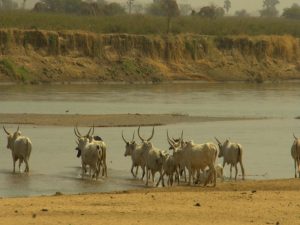
One of Africa’s deadliest conflicts receives far less attention than terrorism. Since 2010, over 15,000 people have been killed in clashes between cattle herders and farmers.
In Nigeria, Taraba, Adamawa, Nassarawa, Benue State, Plateau, and Kaduna states have recorded the most violent attacks and clashes between cattle herders and farmers in recent times.
More Nigerians have been killed in these clashes than from Boko Haram.
With vigilantes and tribes carrying out extrajudicial killings and reprisal attacks the conflict persists with no end in sight.
Why This Is Happening
As the Sahara Desert advances southward, herders migrate with their cattle in search of pasture and water, bringing them into direct collision with settled farming communities. Drought and desertification in northern Nigeria have also devastated traditional grazing routes, while Nigeria’s population exploded to about 237.5 million in 2025, intensifying competition for fertile land.
Urbanization and population growth also led people to build on historical cattle routes, even though there are about 415 grazing reserves across the country which the government hopes will help solve the problem of access to land and restrict cattle from encroaching farmlands. Yet, farmers accuse herders of allowing cattle destroy their crops, while herders face shrinking grazing routes as private farms and urban expansion encroach on traditional pathways they have used for generations.
With herders and farming communities having access to sophisticated weapons illegally, disputes which used to be resolved by traditional chiefs, escalate into armed confrontations. The conflict has now evolved from spontaneous reactions to planned, coordinated attacks and kidnappings for ransom. The crisis is now exploited along identity lines, taking on dangerous ethno-religious overtones, deepening mistrust and making reconciliation difficult.
Historical Roots of the Conflict
Long before borders or nations, Africans survived by what the land offered freely; wild animals, roots, and fruits plucked from trees. From prehistoric times, Africans hunted and gathered the earth’s natural provisions for sustenance. But they needed to innovate to survive . Soon, these prehistoric communities learned how to cultivate land for food and the grazing of cattle for meat. They tilled the earth to grow crops and domesticated cattle for milk and meat. This agricultural revolution pushed Africans into two distinct paths. Farmers sank roots deep, building permanent settlements around their fields, with their lives governed by planting and harvest seasons. While herders, followed their cattle across vast lands in search of greener pastures.
There are about 371 ethnic groups in Nigeria speaking over 520 languages. The Fulbe people or Fulani are renowned cattle herders. Their nomadic lifestyle and cattle rearing culture carries them Across West Africa. They have a strong bond that defies geographical boundaries. Modern Fulani society is divided into two. The settlers and the true nomads. The settlers have roots in many states across Nigeria where over twenty million Fulani live. Adamawa state has a large number of native Fulani living in towns and villages where the traditional language “Fulfulde” is widely spoken. Ninety-nine percent of the settlers practice Islam. This group has integrated well into society, living peacefully with other ethnic groups.
The true nomads however continue to roam across West Africa in search of grazing land for their cattle. Many of this group are animists who do not practice Islam. They often live away from the civilization of modern cities and rural areas. They do not believe in the law and order of modern societies, governed by their own code of conduct, often paying no heed to constituted authorities.
Conflict and Survival Strategies
Conflict threads through every human society. This is an inevitable consequence of competing needs. What separates coexistence from catastrophe is how communities choose to manage these tensions, whether they build bridges or battlegrounds.
When humans evolved from relying on what was readily available in nature to agriculture, farmers mostly established sedentary lifestyles to produce food, while nomadic cultures evolved around the need to move cattle in search of greener pastures.
This set the stage for the collision of two forces of nature.
In Nigeria, traditional rulers often helped manage disputes in villages and small communities. The enforcement of “Jangali” cattle tax provided funding and held cattle herders accountable for their traversing.
Jangali was a social contract that acknowledged the herders’ passage through farming communities while providing resources to address the disruptions their movement inevitably caused.
Taraba state was one of the first in Northern Nigeria to institute an anti-grazing law in July 2017, following series of clashes between farmers and herdsmen. The anti-grazing law did not take into account the fact that many farmlands have encroached government delineated grazing routes.
In the nineteenth century cattle routes ran through Niger, Chad and Cameroon into Nigeria. By 1964 the Nigerian government gazetted 6.4 million hectares of forest reserve for grazing. By 2009, 15 additional international cattle routes were established. But demographic expansions have pushed development of township areas into the old cattle routes. The Taraba anti grazing law outlawed open grazing of cattle. Other states followed suit.
Sustainable Solutions
Nigeria’s farming communities form the skeletal structure upon which the nation’s food security rests. Despite oil’s dominance in export revenues, agriculture employs roughly 70 percent of Nigeria’s workforce and contributes significantly to GDP, with smallholder farmers producing the bulk of domestic food consumption—yams, cassava, maize, rice, and vegetables that fill markets from Lagos to Maiduguri.
These sedentary agricultural communities anchor rural economies. They generate employment across value chains from planting to processing, and represent the country’s best defense against the volatility of global food prices and import dependency.
When farmlands face disruption, whether from conflict, climate shocks, or encroachment, the ripple effect goes beyond small villages. Food inflation rises, worsening food insecurity. For a nation of over 200 million people and counting, the productivity and stability of farming communities is an existential imperative.
Cattle require diverse vegetation across seasons, and confining them to fixed ranches in regions where rainfall is erratic and pasture quality fluctuates transforms livestock management from sustainable practice into expensive gamble.
The infrastructure costs form fencing, water systems, fodder storage, and veterinary facilities, place ranching beyond the reach of communities operating on subsistence margins.
Grazing provides manure from cow dung and natural aeration of the soil as cattle trudge the land.Pastoralists access cattle routes during dry seasons, moving herds strategically to prevent overgrazing while maintaining the lean, efficient production model that has sustained their livelihoods for generations.
In areas where formal land tenure remains contested and capital scarce, restricting this mobility does not modernize the livestock sector.
It threatens to collapse it, pushing herders toward desperation and potentially deeper into the very conflicts that restrictions aim to prevent.
A Path Forward
What traditional rulers once settled with dialogue and customary law now erupts in automatic gunfire. The conflict has escalated beyond land disputes into banditry, kidnapping economies, and the weaponisation of ethnic and religious identities that poison the possibility of reconciliation.
Peaceful coexistence requires deliberate efforts from all parties. For herders, this means embracing designated grazing reserves. Seasonal migration corridors should be negotiated with farming communities. Government investment in veterinary services, water infrastructure, and conflict early-warning systems will also help prevent violent conflict.
Farmers, must also recognize the economic realities of cattle production and participate in frameworks that allow controlled access to fallow lands and grazing reserves during critical seasons.
The authority of traditional institutions should be revisited by government. Not as relics, but as historical structures equipped with legal backing and resources to enforce agreements before disputes breakdown into violence.
The solutions exist in Nigeria’s own history: the Jangali system that created accountability, the indigenous land-sharing arrangements that acknowledged seasonal rhythms, and the elders who held moral authority across ethnic lines.
The political will to depoliticise this crisis, strip away its ethnic and religious disguises, and return it to what it fundamentally is; a resource management challenge between two groups who need access to scarce resources. This will perhaps provide a lasting solution against violent conflict between herders and farmers in Nigeria.