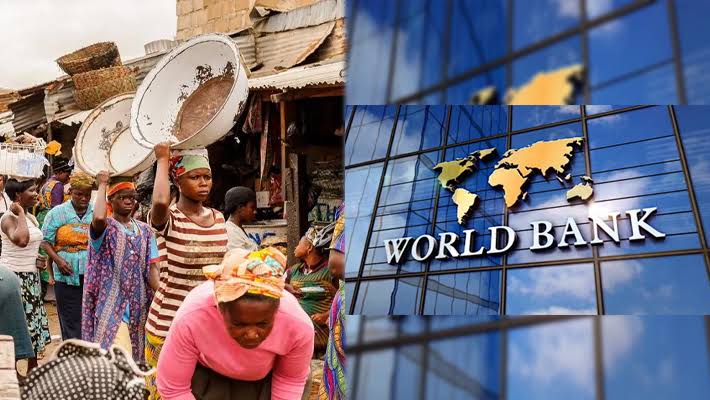
When the World Bank dropped its startling estimate that 139 million Nigerians live in poverty, it sent shockwaves through Abuja and beyond. But instead of introspection, the presidency struck back, declaring the figure “unrealistic” and accusing the Bank of ignoring local complexities.
On the 9th of October, Sunday Dare, Special Adviser to President Tinubu on Media and Public Communication, took to the government’s official channels to challenge the numbers. He argued that the poverty threshold used by the Bank $2.15 per person per day, derived from 2017 PPP (Purchasing Power Parity) is a theoretical construct rather than a real-time account of Nigerian lives. When translated into naira, he pointed out, that threshold equals about ₦100,000 per month, higher than the country’s current minimum wage of ₦70,000.
Dare stressed that poverty models built on historical consumption data Nigeria’s most recent household survey is from 2018/19 cannot capture the full picture of today’s informal economies or subsistence living. He insisted that the numbers be treated as projections, not as reflections of everyday life in 2025.
To buttress the counterargument, the presidency highlighted ongoing government programmes aimed at cushioning the vulnerable. Among them:
- Expanded Conditional Cash Transfers, now targeting up to 15 million households via digital enrolment. Over ₦297 billion has reportedly been disbursed since 2023.
- The Renewed Hope Ward Development Programme, intended to deliver micro‑infrastructure and services to all 8,809 wards across Nigeria.
- Strengthened social investments, including N‑Power, GEEP micro‑loans (TraderMoni, MarketMoni, FarmerMoni), and a revitalized Home‑Grown School Feeding programme.
- Efforts aimed at boosting food security: subsidized grains, fertilizer distribution, mechanization, and the relaunch of strategic food reserves.
- Infrastructure investments via the Renewed Hope Infrastructure Fund, and partnerships to expand credit through risk‑sharing with commercial banks.
Dare framed these interventions as the real measure of government’s commitment to poverty reduction: “growth must translate to improved living standards,” he asserted, adding that Nigeria rejects “exaggerated statistical interpretations detached from local realities.”
Still, the World Bank stood its ground. In Abuja at the unveiling of the Nigeria Development Update report, Nigeria Country Director Mathew Verghis reaffirmed the 139 million figure but also praised Nigeria’s reform efforts. He warned, however, that deeper changes are needed to improve livelihoods.
This clash is more than a numbers dispute. It’s a battle over narrative and legitimacy. The presidency is trying to control how poverty is viewed, while international organizations aim to spotlight persistent structural challenges.
The real test might lie beyond the rhetoric: Can the government’s programmes deliver measurable impact that shifts the story from statistical debate to visible progress in food security, job creation, earnings, and the reduction of inequality?
Only time and data collected in coming surveys will tell which picture ends up closer to Nigeria’s lived reality.