
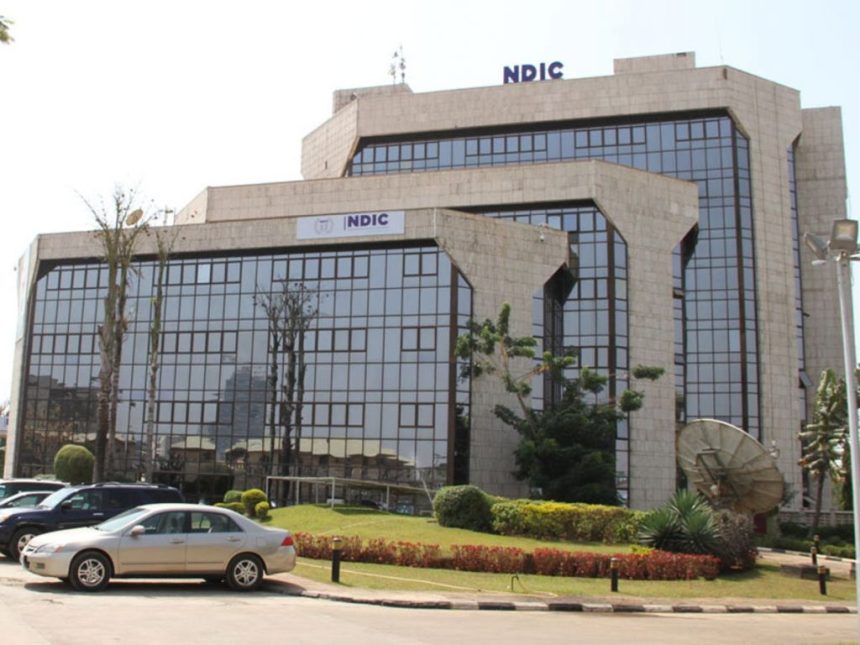
The Nigeria Deposit Insurance Corporation (NDIC) has announced a significant increase in deposit insurance coverage a move it says now fully protects about 99% of depositors in commercial banks and other deposit-taking institutions. The changes are meant to bolster depositor confidence and strengthen financial stability in Nigeria.
At a recent press conference, the NDIC Managing Director/CEO, Bello Hassan, disclosed that the maximum deposit insurance coverage for Deposit Money Banks (DMBs) has been increased from N500,000 to N5,000,000.
The increase was approved by the NDIC’s Interim Management Committee (IMC) during its 18th meeting on April 24-25, 2024.
98.98% of depositors in commercial banks are now fully insured under the new N5 million coverage cap.
In microfinance banks (MFBs), the coverage was raised from N200,000 to N2,000,000, which now insures 99.27% of MFB depositors.
For Primary Mortgage Banks (PMBs), the cap is now N2,000,000, covering 99.34% of depositors.
In short, nearly all ordinary depositors especially those with modest balances now have full protection under NDIC’s deposit insurance scheme.
Greater peace of mind: Small and medium depositors no longer need to worry that the failure of a bank could wipe out their savings (up to the new insured limit).
Enhanced financial inclusion: The increased coverage could encourage more Nigerians to use formal banking channels knowing that their savings are safer.
Stability in the banking system: When depositors trust that their funds are protected, there’s less risk of panic-withdrawals (bank runs) in times of uncertainty. NDIC cited global lessons where high levels of uninsured depositors intensified banking crises.
Despite the expanded coverage:
Not all deposit value is insured. In commercial banks, only about 25.37% of the total value of deposits is now covered under the N5 million cap. Depositors with balances above that amount will have the excess uninsured.
Similarly, coverage in some other categories (like PMBs, PSBs) doesn’t fully cover the value of large deposits.
The protection applies only to licensed deposit-taking institutions. Deposits in unlicensed or informal entities are not covered.
NDIC’s MD cited several reasons:
The need to align with international best practices (including IADI International Association of Deposit Insurers) requiring periodic evaluation of coverage levels.
Considerations such as inflation, per-capita GDP, exchange rate, deposit distribution, and statistical modelling.
Desire to protect a large majority of small depositors while maintaining fiscal sustainability and avoiding moral hazard.
If many depositors have balances above the insured cap, there’s still a vulnerability for those “excess” portions.
How quickly NDIC can respond to a bank failure and pay depositors under the new limits will be important for public confidence.
Whether this change will lead to improved service, less risk-taking by banks, and stronger regulatory oversight.
NDIC’s expansion of deposit insurance is a major win for most Nigerians: about 99% of depositors are now fully insured for deposits up to N5 million (for commercial banks). While this doesn’t cover all funds held by people with larger balances, it significantly reduces risk for the majority. The move is intended to strengthen trust in the banking system, promote greater financial inclusion, and help safeguard ordinary savers.