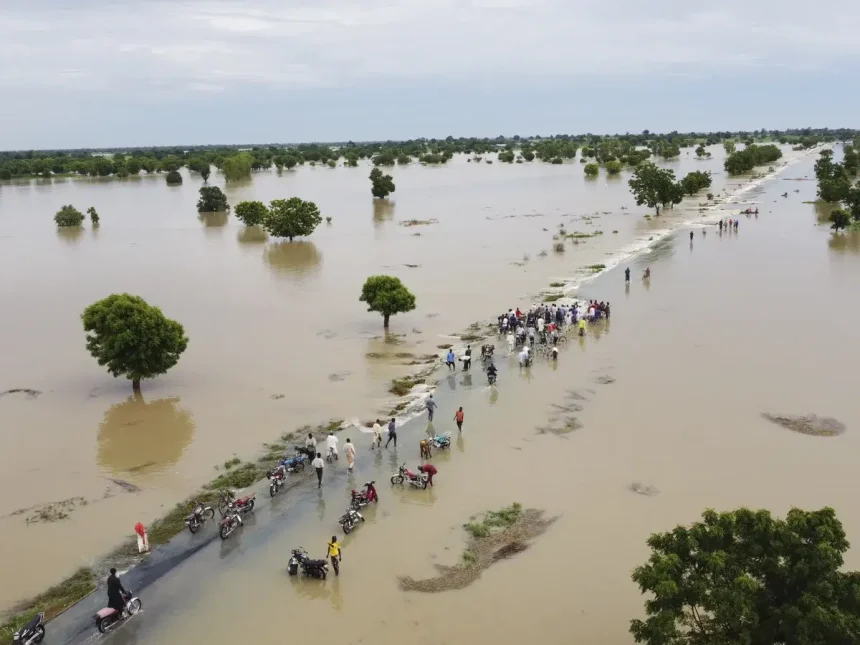
The Niger State Government has issued a fresh warning to residents of flood-prone areas to urgently relocate, following plans for the release of excess water from major dams across the country. Officials say the action is a precautionary step to prevent devastating losses, as water levels continue to rise in the River Niger and surrounding tributaries.
Every year during the rainy season, the controlled release of water from upstream dams, particularly Kainji, Jebba, and Shiroro, poses a threat to communities downstream. This, combined with heavy rainfall, often leads to severe flooding.
The Nigeria Hydrological Services Agency (NIHSA) had earlier warned of above-average rainfall across several states in 2025, naming Niger, Kwara, Kogi, and Kebbi among those at high risk.
Memories of the 2022 floods remain fresh. That disaster killed over 600 people nationwide and displaced more than 2 million. Niger State was among the worst-hit, with submerged homes, destroyed farmlands, and disrupted livelihoods.
The Niger State Emergency Management Agency (NSEMA) confirmed it had received signals from dam operators and federal authorities about planned releases.
NSEMA’s Director General, Alhaji Abdullahi Baba-Arah, said:
“We are appealing to residents in flood-prone areas to begin relocation immediately. Our concern is the safety of lives. Properties can be replaced, but lives cannot.”
He added that identified high-risk local government areas include Shiroro, Borgu, Mokwa, Lapai, and Agaie.
Flooding in Niger State threatens more than homes. Agriculture, the state’s economic backbone, often suffers the heaviest blow. Rice, maize, cassava, and sugarcane farmlands are repeatedly washed away.
Musa Abdullahi, a farmer in Lapai, shared his fears:
“Last year, the water came suddenly, and we lost everything. We are already struggling with high food prices. If we lose our farms again this year, how will we survive?”
The state government says temporary shelters have been set up in safer locations for displaced families. Relief materials, including food and medical supplies, are being stocked, while local governments are on standby with trucks and boats to aid evacuation.
The National Emergency Management Agency (NEMA) also pledged support. Its North-Central Zonal Coordinator, Eugene Nyelong, said:
“We are working with states to reduce casualties through proactive evacuation. Floods are natural disasters, but preparation reduces the damage.”
Climate researchers insist that relocation is only a short-term measure. They argue that recurring disasters point to a deeper issue of poor planning and lack of long-term adaptation strategies.
Dr. Ifeoma Nwosu, an environmental expert, noted:
“Relocation is important now, but people go back to the same danger zones because they have nowhere else to go. Government must provide safer, affordable housing and invest in infrastructure to manage rising water levels.”
Online, reactions to the relocation warning have been mixed.
On X, one user, @Aliyu_Sule, posted: “Good move by Niger State. Prevention is better than cure.”
Another, @ZainabKolo, countered: “Where do they expect poor villagers to go? Government should provide real solutions, not just warnings.”
With dam releases set to begin, Niger State faces a familiar test. The government’s call for relocation may save lives, but long-term solutions remain elusive. For now, residents are urged to act quickly, as the danger of rising waters looms once again.