
By Aisha Muhammad Magaji
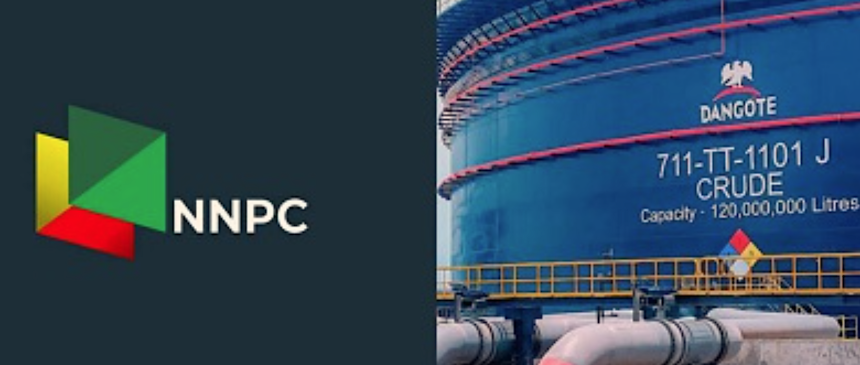
The Nigerian National Petroleum Company Limited (NNPC) has entered into a new two-year crude oil supply agreement with Dangote Petroleum Refinery, a move seen as pivotal to stabilising domestic fuel supply and strengthening Nigeria’s refining capacity.
The deal, which was signed in August 2025, will ensure the continuous supply of crude oil to Africa’s largest refinery, located in Lekki, Lagos. Under the terms, the refinery will receive a significant portion of its crude allocation in naira as part of the federal government’s ongoing “crude-for-naira” initiative aimed at easing pressure on foreign exchange.
According to details released by NNPC, about 82 million barrels of crude have been earmarked for Dangote Refinery between October 2024 and September 2025. Of this, roughly 60 percent equivalent to 49.3 million barrelswill be supplied in naira.
Andy Odeh, Chief Corporate Communications Officer of NNPC, explained that the arrangement would be monitored by a joint committee. “NNPC, Dangote Refinery, and the Nigerian Midstream and Downstream Petroleum Regulatory Authority will periodically reconcile the volume and cost of crude delivered in naira. This ensures transparency and accountability in the system,” Odeh said.
He confirmed that naira-denominated cargoes had already been delivered in August, September, and October under the renewed arrangement.
This agreement comes on the heels of recent tensions between Dangote Refinery and federal authorities. In September, the refinery temporarily suspended petrol sales in naira, citing concerns over insufficient crude allocation under the crude-for-naira scheme. The issue was later resolved following intervention by the Naira-for-Crude Technical Committee, allowing sales to resume.
Industry experts view the fresh deal as a stabilising measure to prevent future disruptions. By guaranteeing supply for the next two years, the government hopes to bolster fuel availability across the country and reduce reliance on imported refined products.
Oil marketers and downstream stakeholders have welcomed the agreement. Hammed Fashola, Vice President of the Independent Petroleum Marketers Association of Nigeria (IPMAN), described it as a step in the right direction. “It is a good development. It will bring stability. If they can renew it and get it going on, it is good for the system; it will bring stability,” he said.
IPMAN spokesperson Chinedu Ukadike, however, called for a balanced approach that also considers modular refineries. “You cannot be exporting crude while Dangote is importing crude,” he noted, stressing that smaller domestic refiners should not be neglected in the supply chain.
Despite optimism, questions remain about the sustainability of the crude-for-naira model, especially given the volatility of the naira. There are also concerns over:
Adequacy of supply: If the refinery does not receive the agreed volume, it may be forced to rely again on imported crude.
Labour disputes: Dangote Refinery is currently facing tension with the Petroleum and Natural Gas Senior Staff Association of Nigeria (PENGASSAN) over recent mass layoffs, which could disrupt operations.
Policy consistency: Experts warn that political and economic shifts could undermine the government’s ability to maintain long-term commitments.
For ordinary Nigerians, the deal signals hope for more stable fuel supply and reduced dependence on imported petroleum products, which often lead to high pump prices and scarcity. If fully implemented, the agreement could also strengthen the naira by reducing forex outflows for crude transactions.
The refinery, which has a nameplate capacity of 650,000 barrels per day, is expected to play a central role in Nigeria’s quest for energy self-sufficiency. Analysts argue that ensuring consistent crude feedstock is the first step toward achieving this goal.
For now, the NNPC–Dangote pact provides a strong platform to sustain operations at the refinery while giving Nigeria a chance to gradually reposition itself as a regional refining hub.