By Aisha Muhammad Magaji
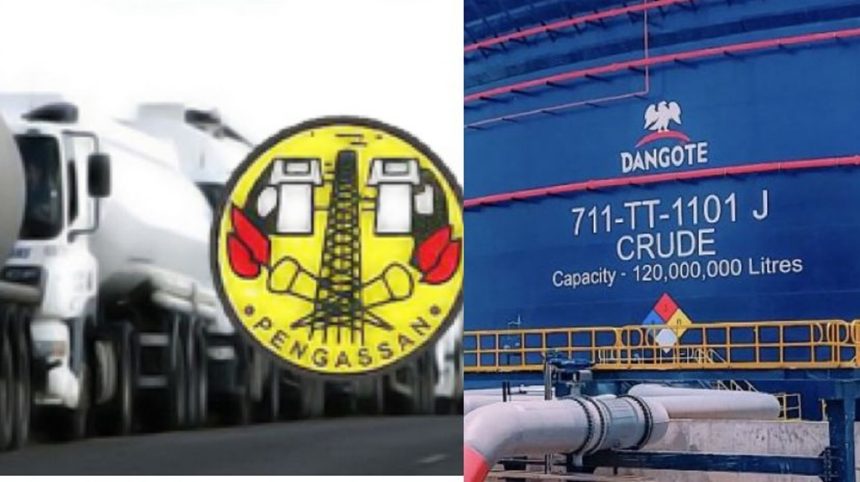
The Federal Government has stepped into the escalating labour crisis between the Petroleum and Natural Gas Senior Staff Association of Nigeria (PENGASSAN) and Dangote Refinery, appealing to the union to suspend its planned nationwide strike as high-level truce talks are set to hold today in Abuja.
The dispute erupted after PENGASSAN accused the refinery of sacking over 800 Nigerian workers who had joined the union, replacing them with foreign staff, mostly from India. The union described the action as a “deliberate violation” of Nigeria’s labour laws, the Constitution, and International Labour Organisation (ILO) conventions.
In a communique issued after its emergency National Executive Council (NEC) meeting on Saturday, PENGASSAN directed all members across oil fields, refineries, corporate offices, and support services to begin a total withdrawal of services from Monday, September 29, 2025. The directive also included halting crude oil and gas supply to Dangote Refinery.
The association warned that the decision was necessary to resist what it called the “enslavement of Nigerian workers,” stressing that the sacked staff were breadwinners whose families are now left in hardship.
“No man or company, no matter how highly placed, is above the law. The over 800 Nigerian families affected cannot be sacrificed on the altar of impunity,” PENGASSAN General Secretary, Comrade Lumumba Okugbawa, said in the statement.
Minister of Labour and Employment, Nkeiruka Onyejeocha, confirmed in a Sunday night statement that government has invited both PENGASSAN leadership and Dangote Refinery management for an emergency reconciliation meeting.
“We are deeply concerned about the potential economic and social impact of this strike, particularly on energy security. Government has called all parties to the table today for dialogue, and we expect that both sides will demonstrate good faith in resolving this matter,” the minister said.
Onyejeocha added that while government recognises the constitutional right of workers to unionise, it was also working to ensure industrial harmony to prevent disruption to national economic activities.
The strike threat has already raised alarm within Nigeria’s fragile power sector. The Association of Power Generation Companies (APGC) warned that an indefinite withdrawal of gas and crude supply could cripple thermal power plants, which provide over 70% of Nigeria’s electricity.
“If gas supply is disrupted, we are likely to see plants shut down within 48 to 72 hours, leading to a nationwide blackout,” APGC spokesperson Joy Ogaji told journalists in Abuja.
Nigeria is already battling with low generation capacity, frequent grid collapses, and rising electricity tariffs. Analysts warn that a blackout would further stoke public frustration at a time when Nigerians are grappling with soaring inflation, food prices, and naira depreciation.
While Dangote Refinery has yet to issue a detailed statement, sources within the company insist the restructuring exercise was necessary for efficiency. They denied allegations of replacing Nigerians wholesale with foreign staff, saying expatriates are only brought in to fill highly technical roles until Nigerians are fully trained.
The $20 billion refinery, commissioned in May 2023, was designed to produce 650,000 barrels per day of refined products, making it Africa’s largest refinery and a critical part of Nigeria’s energy transition. Any sustained disruption to its operations could undermine national fuel supply and foreign exchange earnings.
The crisis has also drawn reactions from political leaders and labour activists. The Nigeria Labour Congress (NLC) threw its weight behind PENGASSAN, warning that “no employer, no matter how influential, should trample on workers’ rights.”
Opposition lawmakers in the National Assembly have urged President Bola Tinubu to personally intervene to prevent the standoff from degenerating into a full-scale industrial crisis.
“The sacking of Nigerians to replace them with foreigners is not only unjust but unpatriotic. Government must ensure fairness, protect Nigerian jobs, and safeguard the stability of the energy sector,” Senator Shehu Sani said in a statement.
Nigeria’s oil and gas industry remains the backbone of its economy, contributing about 65% of government revenue and over 80% of foreign exchange earnings, according to the Central Bank of Nigeria (CBN). A prolonged strike in the sector could worsen fuel scarcity, disrupt electricity supply, and erode investor confidence.
Energy analyst Bala Zakka noted: “This dispute is bigger than just labour and Dangote Refinery. It speaks to the heart of Nigeria’s economic stability. If crude and gas flows stop, the consequences will ripple across households, industries, and the financial system.”
As Nigerians await the outcome of today’s truce meeting, there is widespread anxiety that a collapse in negotiations could plunge the country into another round of nationwide hardship.
For millions of Nigerians who have endured fuel queues, unstable electricity, and high living costs, the hope is that both PENGASSAN and Dangote will reach a compromise that protects workers’ rights without jeopardising the nation’s economic survival.
“The government must ensure fairness and dialogue,” said Lagos-based trader Ifeoma Nwosu. “We cannot afford another crisis that will make life harder than it already is.”
All eyes are now on Abuja, where the truce meeting is expected to decide whether Nigeria averts a crippling nationwide strike or slides deeper into economic uncertainty.