By Aisha Muhammad Magaji
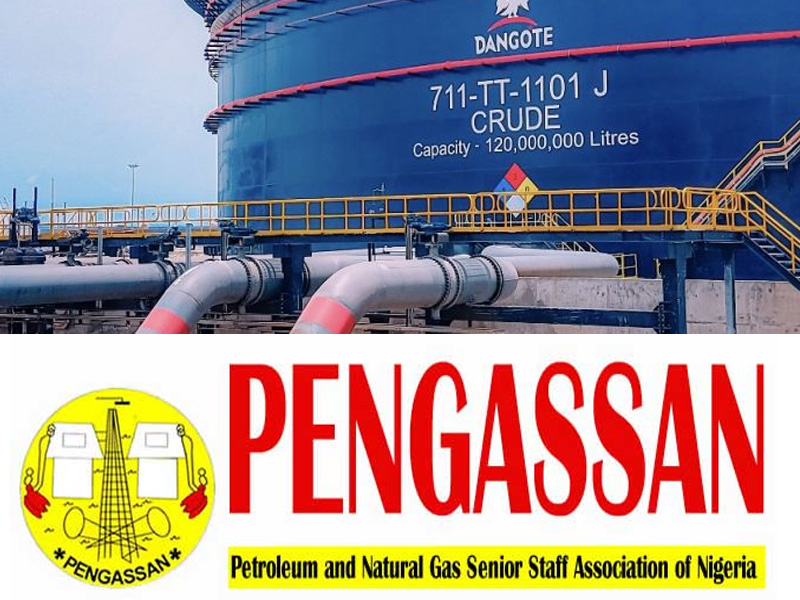
The Petroleum and Natural Gas Senior Staff Association of Nigeria (PENGASSAN) has declared a nationwide withdrawal of services following what it described as the unlawful sack of more than 800 Nigerian workers at the Dangote Refinery. The union said the move was a direct attack on organized labour and warned that it could set a dangerous precedent for Nigeria’s industrial relations if left unchallenged.
The decision was announced on Saturday, September 27, 2025, after an emergency meeting of PENGASSAN’s National Executive Council (NEC). The union directed all members in oilfield locations to begin a total strike from Sunday, September 28, while those in offices, agencies, and institutions are to stop work from Monday, September 29.
“An Affront to Workers”
In a statement signed by the association’s General Secretary, Comrade Lumumba Ighotemu Okugbawa, PENGASSAN accused Dangote Refinery of victimizing workers who joined the union, in violation of Nigeria’s labour laws, the Constitution, and International Labour Organization (ILO) conventions.
“This unilateral action to sack over 800 members of our Association for joining PENGASSAN is an affront to all workers in Nigeria and a deliberate violation of Nigeria’s labour laws,” Okugbawa said.
He added that no company, regardless of size or influence, was above the law.
“No man or company, no matter how highly placed, is above the law and cannot be called to order by Nigerians. Over 800 families have been thrown into distress, while their jobs have been handed over to expatriates. This is an injustice we cannot tolerate,” he said.
According to PENGASSAN, Dangote Refinery has developed a reputation for “enslaving Nigerian workers” while allegedly favoring foreign employees. The NEC accused the refinery of replacing sacked Nigerian staff with more than 2,000 Indian workers, describing the move as an act of “disloyalty to a country that has given the refinery unprecedented incentives at taxpayers’ expense.”
“The lives of Nigerian workers cannot be so cheaply traded. This is about equity, justice, and dignity for the Nigerian people,” the statement read.
The association also claimed that workers at the refinery were subjected to “slave-like conditions,” with poor welfare packages and unfair treatment compared to their foreign counterparts.
The NEC resolutions outlined far-reaching actions that could paralyze parts of the oil and gas industry. Among them:
- Withdrawal of Services: All PENGASSAN members in oilfield locations are to withdraw their services from 6:00 a.m. on Sunday, September 28, including control room operations, panel operations, and outfield duties.
- Nationwide Shutdown: Members in offices, companies, institutions, and agencies are to stop work from 12:01 a.m. on Monday, September 29.
- Supply Cut: All crude oil and gas supplies to Dangote Refinery are to be halted immediately.
- Production Ramp-Up Elsewhere: International Oil Companies (IOCs) have been directed to increase production and supply to other facilities in order to stabilize output.
The union emphasized that no clearance for exceptions would be accepted unless granted directly by its National Secretariat.
The strike threatens to disrupt operations at the 650,000 barrels-per-day Dangote Refinery, which is widely regarded as a critical pillar of Nigeria’s energy future. The facility, which recently reinstated naira-based petrol sales after a brief suspension, accounts for a significant share of Nigeria’s fuel supply.
Energy analysts say a prolonged strike could worsen petrol scarcity across the country, drive up prices, and deepen Nigeria’s energy insecurity. With international oil markets already volatile, a halt in supplies to the refinery could also dent investor confidence in the country’s oil and gas sector.
Dr. Andrew Eke, an oil and gas analyst based in Lagos, said the strike could have “serious ripple effects.”
“If crude supply to Dangote Refinery is halted for a prolonged period, we may see a disruption in domestic fuel availability, increased reliance on imports, and potential hikes in pump prices,” he said. “It is in everyone’s interest government, labour, and management to resolve this dispute quickly.”
PENGASSAN urged the Federal Government to wade into the crisis, stressing that failure to act decisively could embolden companies to trample on workers’ rights.
“The over 800 staff whose jobs have been given to foreigners are Nigerians and breadwinners of families. They must not be made to suffer unjustly,” Okugbawa said. “This is an urgent need to avoid setting a dangerous precedent.”
The union also framed the strike as part of a larger struggle to defend workers’ dignity in Nigeria.
“An injury to one is an injury to all. This fight is not just about PENGASSAN members it is about protecting every Nigerian worker from oppression,” the NEC resolution stated.
This is not the first time Nigeria’s oil and gas sector has been disrupted by industrial action. In the past decade, both PENGASSAN and the Nigeria Union of Petroleum and Natural Gas Workers (NUPENG) have staged nationwide strikes over issues ranging from fuel subsidy removal to poor working conditions. These strikes have often resulted in fuel scarcity, long queues at filling stations, and soaring black-market prices.
Labour experts warn that unless systemic reforms are made to strengthen labour relations and enforce laws, disputes such as the current one with Dangote Refinery will remain a recurring problem.
As of press time, Dangote Refinery has not issued an official response to the allegations or the strike directive. Calls and emails to the company’s media office went unanswered.
Meanwhile, Nigerians are bracing for the impact of a fresh disruption in fuel supply, with many fearing that the coming days may bring long queues at petrol stations and possible hikes in pump prices.