
By Aisha Muhammad Magaji
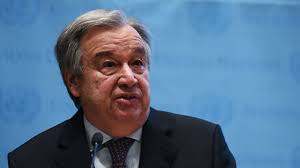
United Nations Secretary-General António Guterres has warned that the world is facing an escalating nuclear threat, urging nations to return to dialogue and work toward disarmament before it is too late. Speaking at the opening of the UN General Assembly’s high-level week on Monday, Guterres described the current global nuclear landscape as “perilously unstable.”
“The threat of nuclear weapons is growing, not shrinking,” Guterres said in his address. “We are witnessing new arms races, modernizations of nuclear arsenals, and an erosion of long-standing disarmament agreements. Humanity cannot afford complacency.”
The UN chief emphasized that geopolitical tensions in multiple regions, including Eastern Europe, the Middle East, and the Korean Peninsula, have fueled uncertainty and increased the risk of miscalculations.
“Every nuclear weapon ever built has the potential to destroy civilization,” he stated. “We must act decisively to prevent any scenario where these weapons are used, whether by accident, miscalculation, or intent.”
According to the Stockholm International Peace Research Institute (SIPRI), the world’s nine nuclear-armed states United States, Russia, China, France, the United Kingdom, India, Pakistan, Israel, and North Korea collectively possess over 13,000 nuclear warheads. Recent reports indicate that both Russia and China are expanding and modernizing their nuclear capabilities, while North Korea continues to test missiles in defiance of UN resolutions.
The erosion of arms control agreements, such as the Intermediate-Range Nuclear Forces (INF) Treaty and uncertainties surrounding the New START Treaty between the U.S. and Russia, have also raised alarm among disarmament advocates.
Guterres urged world leaders to embrace multilateral diplomacy and recommit to nuclear non-proliferation frameworks, particularly the Treaty on the Non-Proliferation of Nuclear Weapons (NPT).
“We need renewed leadership, courage, and cooperation to reduce the role of nuclear weapons in national security doctrines,” he said. “Disarmament is not optional it is an existential necessity.”
He also highlighted the humanitarian consequences of any nuclear use, citing UN studies that estimate even a limited nuclear exchange could trigger global food shortages, climate disruption, and millions of deaths.
The UN Secretary-General’s warnings have drawn attention from leaders and experts around the world.
Ambassador Elayne Whyte Gómez of Costa Rica, chair of the First Committee of the UN General Assembly on Disarmament, praised Guterres’ speech, saying, “This is a critical moment. The Secretary-General has reminded us that we must prioritize disarmament, strengthen treaties, and foster dialogue before tensions spiral out of control.”
Similarly, members of the International Campaign to Abolish Nuclear Weapons (ICAN), which won the 2017 Nobel Peace Prize, welcomed the address. “The UN is sending a clear signal: nuclear weapons must not be normalized. We need action, not just words,” said ICAN spokesperson Beatrice Fihn.
Despite global appeals, obstacles remain. Nuclear-armed states continue to justify weapons modernization as a deterrent, citing regional security threats and strategic competition. Analysts warn that bridging the trust gap between nations will require sustained negotiations, verification mechanisms, and political courage.
“The current geopolitical climate is tense, and any misstep could have catastrophic consequences,” said Dr. Rajiv Chandrasekar, a security expert at the Stockholm Peace Institute. “The UN chief’s call is timely, but implementation depends on genuine commitment from the nuclear powers.”
Guterres also called on citizens, civil society, and media organizations to raise awareness about the nuclear threat. “Disarmament is a global responsibility, not just a government task. People must demand accountability and advocate for a safer world,” he said.
The UN is expected to host multiple forums over the next few months aimed at strengthening nuclear risk reduction measures, enhancing verification protocols, and encouraging cooperation among member states.
As world powers navigate rising geopolitical tensions, Guterres’ warning underscores the urgent need for international collaboration and proactive measures. The Secretary-General concluded his address with a stark reminder:
“The time for complacency is over. The decisions we make today will determine whether humanity survives or succumbs to the consequences of nuclear folly.”