By Aisha Muhammad Magaji
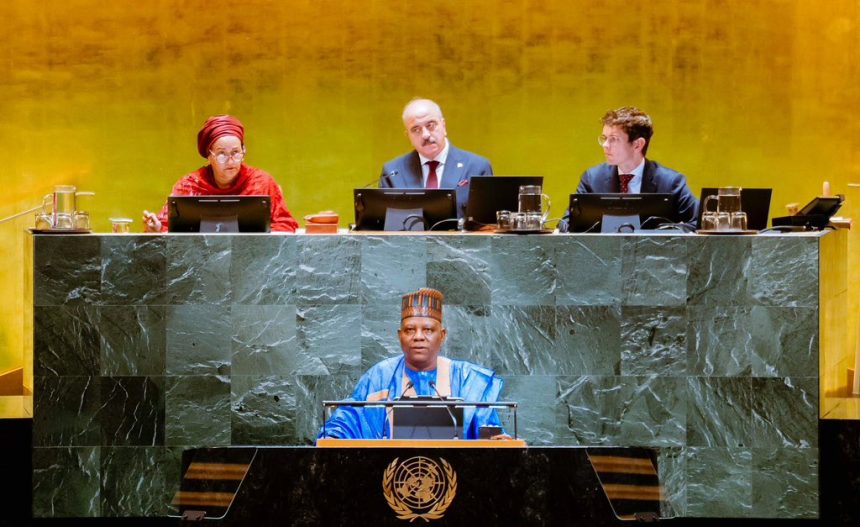
Nigeria’s Vice President, Kashim Shettima, on Wednesday, represented President Bola Ahmed Tinubu at the 80th United Nations General Assembly (UNGA) in New York, where he delivered Nigeria’s national statement to world leaders.
The Vice President’s address emphasized Nigeria’s commitment to multilateralism, UN reform, climate action, economic resilience, and sustainable development. It also reaffirmed the country’s role as Africa’s largest democracy and a key player in shaping global responses to pressing challenges.
A focus on multilateralism and reform
In his statement, VP Shettima relayed President Tinubu’s call for a stronger, reformed United Nations system that reflects the realities of the 21st century. Nigeria, he said, continues to support the expansion of the UN Security Council to give Africa and other underrepresented regions a greater voice in global decision-making.
“Reform is long overdue,” Shettima told delegates. “We must create a system that is inclusive, accountable, and capable of addressing the shared challenges of our time.”
Climate change and energy transition
Climate action was a recurring theme in the Nigerian delegation’s message. With extreme weather events increasingly affecting West Africa, Shettima urged advanced economies to honor climate finance pledges to developing nations. He also highlighted Nigeria’s investments in renewable energy and gas as part of its energy transition plan.
“We are not just victims of climate change we are partners in finding solutions,” he said. “Nigeria seeks global collaboration to balance development needs with sustainability goals.”
Economic resilience and debt reform
On the economic front, Shettima stressed the urgent need for international financial reform. He criticized the burden of unsustainable debt on developing economies, calling for fairer lending practices and innovative financing for infrastructure and human capital development.
He pointed to Nigeria’s efforts to diversify its economy beyond oil, strengthen food security, and invest in technology as part of Tinubu’s Renewed Hope Agenda.
Global peace and security
Nigeria’s statement also addressed international peace and security, particularly the conflicts in Africa, the Middle East, and Eastern Europe. Shettima reiterated Nigeria’s support for peaceful resolution of conflicts and its ongoing contributions to regional peacekeeping under ECOWAS and the African Union.
“Peace is indivisible,” he noted. “What affects one region affects us all. Nigeria will continue to champion dialogue, democracy, and respect for human rights.”
Bilateral meetings and partnerships
On the sidelines of the UNGA, VP Shettima met with key global leaders, including the President of Namibia and representatives of the Gates Foundation. Discussions reportedly centered on partnerships in healthcare, education, and digital innovation.
Diplomatic sources confirmed that the Vice President also participated in high-level forums on climate adaptation, global health, and financial reform.
Nigeria’s role on the global stage
Observers say the decision for Shettima to deliver Tinubu’s message reflects Nigeria’s commitment to continuity in foreign policy, even when the President is unable to personally attend. Diplomats noted that Shettima’s delivery was “confident, clear, and reflective of Nigeria’s priorities in the multilateral space.”
Foreign policy analyst Prof. Jide Ogundipe told S24 Media House that Nigeria’s presence at UNGA 2025 “underscores its role as Africa’s voice at the global stage, particularly on issues of governance, economic justice, and climate.”
Looking ahead
With the UN marking its 80th session, many see 2025 as a critical year for shaping global cooperation. For Nigeria, the challenge will be translating the commitments outlined in Shettima’s speech into actionable domestic and international policies.
As delegates departed the General Assembly hall, one thing was clear: Nigeria intends to remain a strong advocate for equity, reform, and resilience in a rapidly changing world.