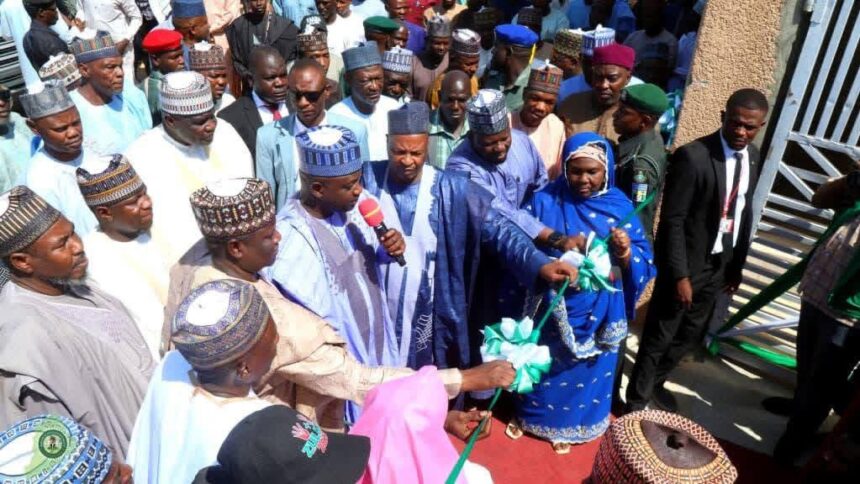
The Acting Governor of Borno State, Umar Usman Kadafur, commissioned six major development projects in Nganzai Local Government Area today.
The visit reaffirmed the state government’s commitment to healthcare delivery, education expansion, and structured post-insurgency recovery across affected communities in Borno.
Among the commissioned projects was a 48-classroom Higher Islamic College in Gajiram, equipped with solar power, computers, meals, and materials.
Additionally, the government unveiled ten AGILE classrooms at Government Day Secondary School, Ngajiram, alongside the Executive Chairman’s official residence.
Read Also: Funding Crisis Forces WFP to Close Nutrition Clinics in Borno
Other projects included solar-powered streetlights, a mega solar borehole, and a shopping complex with chalets at the District Head’s Palace.
Meanwhile, a major highlight was the commissioning of the newly constructed General Hospital, Gajiram, serving surrounding towns and rural communities.
Speaking, Kadafur described healthcare as the truest test of governance, stressing that leadership performance reflects lives saved, not promises made.
He stated that the hospital strengthens healthcare infrastructure, expands access to quality services, and ensures no community remains underserved statewide.
Accordingly, the project aligns with Borno’s 25-Year Development Plan, marking steady transition from recovery toward stability and sustainable development.
Kadafur explained that the hospital corrects rural healthcare imbalances by providing emergency, surgical, maternal, diagnostic, and inpatient services.
The facility operates on hybrid power, combining grid electricity, generators, and solar energy to guarantee uninterrupted medical services delivery.
Furthermore, Kadafur assured continuous recruitment, deployment, training, and welfare support for healthcare workers across all local government areas.
Earlier, Health Commissioner Baba Mallam Gana described the hospital as a practical solution addressing long-standing healthcare gaps in Nganzai.
He noted that the facility reduces referrals, emergency delays, and preventable deaths through full secondary healthcare service delivery.
Meanwhile, lawmakers and local leaders commended the projects, pledging protection, maintenance, and continued collaboration for community recovery and resettlement.